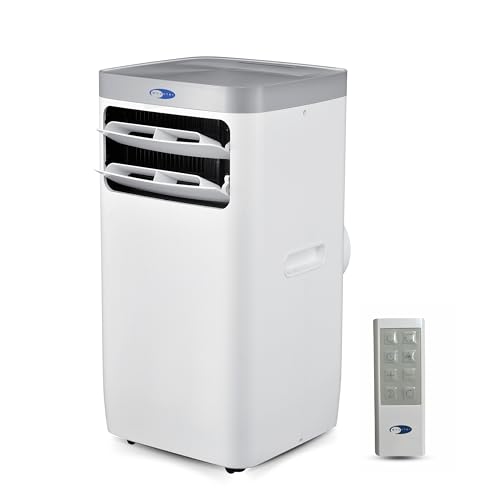
The Whynter ARC-115WG is a mid-sized, cooling-only portable air conditioner aimed at bedrooms, dens and small apartments. Whynter lists it at 11,000 BTU on the ASHRAE basis and 6,800 BTU on the SACC basis, for rooms up to 400 sq ft, with a net weight of 51.25 lb and a noise level under 49 dBA on low. It has casters, a remote control, a 24-hour timer and a washable filter. This profile covers what Whynter publishes, how to read its two BTU figures, venting and drainage, outlet rules, and who is better served by a different model. All specs come from Whynter’s product page and its FAQ. We compared published specs and did not run the unit ourselves.
What Whynter Says About the ARC-115WG
According to Whynter’s product page:
- Capacity: 11,000 BTU (ASHRAE) and 6,800 BTU (SACC), with coverage up to 400 sq ft.
- Modes: Cool, Fan and Dry. Heat mode: No.
- Dehumidifying: 87 pints per day.
- Fan: three speeds, with an airflow of 310 m3/h (182 CFM) on high.
- Temperature range: 61 to 89°F with full thermostatic control.
- Hose system: single hose, with a 5.5 inch diameter exhaust hose up to 59 inches long and a window kit that adjusts from 20 to 46 inches.
- Power: 115 V, 60 Hz, with a maximum cooling power consumption of 1,050 W / 9.5 A.
- Noise: under 49 dBA on low and under 52 dBA on high.
- Controls: digital remote, 24-hour programmable timer, automatic louver swing and auto restart after a power outage.
- Drain: a patented auto drain function plus upper and lower drain ports. No pump.
- Filter: washable.
- Refrigerant: R-32.
- Size and weight: 14.75 x 13.75 x 28 inches (W x D x H), 51.25 lb net and 65.45 lb gross.
- Other: casters, a storage bag, UL listed.
- Warranty: one year on the unit and three years on the compressor.
One detail to check: Whynter’s page title on its own site uses the words dual hose, while the specification table and feature list describe a single hose. We follow the specification table. Confirm what comes in the box before you plan where the hose will run.
SACC vs. ASHRAE: Which BTU Number to Use
Portable air conditioners carry two BTU ratings. The ASHRAE figure, 11,000 BTU here, is the older lab number. The SACC figure, 6,800 BTU here, is the seasonally adjusted cooling capacity from the DOE’s test procedure (10 CFR 430, Subpart B, Appendix CC), which accounts for the heat the unit adds, air leakage through venting and varying room conditions. Whynter’s FAQ gives an example in the same spirit: an older unit rated 14,000 BTU on the old basis might have a SACC of only 8,500 to 10,000 BTU, “not weaker, just more accurately labeled.” The FAQ also says a dual-hose design generally has a higher SACC for the same ASHRAE rating, so expect a single-hose unit like this one to sit further below its ASHRAE number.
When you compare portable ACs, use SACC against SACC. The 6,800 BTU SACC figure, not the 11,000 BTU headline, is the one that reflects how the unit is rated for real-world conditions. Whynter’s own sizing guide in its FAQ points up to 300 sq ft to 8,000 to 10,000 BTU and 300 to 500 sq ft to 11,000 to 14,000 BTU, but it labels that guidance as reference only. Treat the 400 sq ft figure as the upper end for a shaded, well-insulated room. For a sunny room, a kitchen or a space with a lot of electronics, plan on less.
Venting: Single Hose, Window Kit and Where Not to Vent
Whynter’s FAQ is blunt: all portable air conditioners must vent hot air outside. This one uses a single 5.5 inch exhaust hose and a window kit that Whynter says works in vertical (sliding) and horizontal (sash) windows. You measure the window and cut the panel to fit. The kit length runs from 20 to 46 inches.
A few points from Whynter’s FAQ worth knowing before you buy:
- Hose length. Whynter does not recommend extending the exhaust hose, and says if it is unavoidable, stay under 9 feet total and avoid sharp bends. A short, straight hose performs best, so place the unit close to the window.
- Alternatives to a window. Whynter lists vertical sliding doors with a kit, drop-ceiling panels and wall vents. A permanent wall vent or any ceiling work should be done by a licensed contractor, and this profile gives no installation steps for it.
- Casement windows. Whynter says they work with an aftermarket kit or a custom insert.
- Never vent into another room, garage or attic. Whynter says the exhaust carries heat and moisture, which pushes heat back into the home and risks condensation and mold in the receiving space. Exhaust must go outdoors.
- Single vs. dual hose. Whynter explains that a single-hose unit pulls room air to cool the condenser, which is simpler but less efficient in large or sunny rooms.
Drainage
Whynter describes a patented auto drain function that exhausts condensate through the hose in most environments, and it adds that the unit has an upper and a lower drain port. In humid climates the unit may condense more water than it can exhaust, and the display will show STOP, P1 or FL when the internal tank is full. Whynter’s suggestions are dehumidifier mode with a continuous drain hose, draining the lower port into a shallow pan or its ARC-DB drain bucket, or reducing humidity in the room. A hose on the upper port can drain by gravity into a floor drain or bucket if it runs downhill and is not kinked. There is no built-in pump, so drainage depends on gravity.
Outlet and Electrical Rules
Whynter’s FAQ says to plug a portable air conditioner directly into a properly grounded wall outlet rated for the unit, ideally on a dedicated circuit. It says not to use lightweight extension cords, adapters or undersized power strips, because they can overheat. If you use a surge protector or power strip, it must be rated for the unit’s maximum electrical load. The FAQ also says to use the unit’s LCDI safety plug as provided and not to bypass or modify it. With a 1,050 W / 9.5 A maximum draw, sharing a circuit with a microwave or space heater is a common reason for tripped breakers. If you do not have a suitable outlet, Whynter says to consult a licensed electrician, and that is a job for one, not a DIY project.
Setup Tips From Whynter’s FAQ
- Let the unit stand upright for at least 2 hours before plugging it in, and 24 hours if it traveled on its side.
- Wash the washable filters every two weeks in warm water and dry them fully.
- Wait 3 to 5 minutes before restarting the compressor.
- Keep doors closed, close blinds in the daytime and seal the window kit well.
- Store it upright, drained, with filters and hose clean and dry.
Noise
Whynter lists under 49 dBA on low and under 52 dBA on high. Its FAQ says most portable ACs run between 50 and 60 dB, so these numbers are at the quiet end of what the brand describes. Noise varies with fan speed and compressor activity, so check the figure against the room you will use it in.
Where It Falls Short
- Cooling only. No heat mode and no smart control.
- Single-hose design. Less efficient in a large or sunny room than a dual-hose unit.
- No pump. Drainage relies on gravity, the auto drain function or a manual drain.
- Weight. 51.25 lb net is manageable on casters, but awkward on stairs.
- The 400 sq ft rating is a ceiling. The SACC figure is a better guide to real cooling.
Who It Suits
- Renters and homeowners cooling a bedroom, den or small living area who want a quiet, simple, plug-in unit.
- People who want a remote, a timer and auto restart without apps.
- Buyers who like a three-year compressor warranty on top of the one-year unit warranty.
Who Should Look Elsewhere
Bottom Line
The ARC-115WG is a plain, quiet, mid-sized portable AC with clear published specs, a long compressor warranty and a straightforward venting job through a window. Its 6,800 BTU SACC is the figure to size against. For how it compares with the other compact units we cover, see our best small portable air conditioners ranking for 2026. Use the button below to see current pricing on Amazon.
See price on Amazon
Sources