We earn a commission if you buy through our links, at no extra cost to you.
Comparison
Best Small Portable Air Conditioners of 2026: 3 Picks
Three small portable air conditioners ranked for 2026 for dorms, bedrooms and home offices, with SACC and DOE BTU figures, room sizes and warranties.
B By the Best Portable Air Conditioners editorial team ·Published
At a glance
For a small bedroom or dorm that needs headroom, choose the Whynter ARC-115WG, listed at 6,800 BTU SACC for up to 400 sq ft and under 49 dBA on low. The Midea 6,000 BTU Smart Portable AC adds app control for 150 to 250 sq ft, and the Midea 5,000 BTU Portable AC is the simple pick for up to 150 sq ft.
A small room is the easiest place to buy the wrong air conditioner. Too much capacity cycles on and off and costs more to run, and too little never catches up on an afternoon with the sun on the window. This ranking covers the three smaller portable air conditioners on our site: a mid-sized single-hose Whynter and two compact Midea models. They suit dorms, small bedrooms, home offices and studios. If your room is a living room or an open plan, our main ranking of portable air conditioners covers the larger models, including the dual-hose inverters. We compared published specs and did not run the units ourselves.
How We Chose
For small rooms, four things decide the match.
The BTU figure on the right basis. Portable air conditioners carry two kinds of BTU ratings. The older ASHRAE number is a lab figure that does not fully count the heat the unit adds or the warm air that leaks back in around the hose. SACC, the seasonally adjusted cooling capacity from the Department of Energy’s portable air conditioner procedure, counts those losses, and “DOE” on a Midea spec page is the same kind of number. Whynter’s FAQ gives the classic example: a unit labeled 14,000 BTU on the old basis can come out at 8,500 to 10,000 BTU SACC. When a maker gives a SACC or DOE figure, we use it.
Room size. We use each maker’s own square-footage claim, and treat it as a ceiling. A sunny window, a high ceiling or a gaming PC pushes the real need up.
Footprint and weight. Small rooms often mean tight floor space. We list published sizes and weights.
Noise, drainage and extras. Noise only as published, and where a maker publishes nothing, we write “not published” instead of guessing.
Because this is a small-room ranking, the order goes from the most capable unit to the most basic. The Whynter ARC-115WG leads because it has the strongest cooling figure and the only published noise numbers. It is the largest here, so if your room is truly tiny, jump to the 5,000 BTU model.
Outlet and venting rules. Plug a portable air conditioner directly into a properly grounded wall outlet. Midea’s manual for its MAP14-series portables says not to use an extension cord or an adaptor plug, and Whynter says to avoid lightweight extension cords, adapters and undersized power strips and to use a dedicated circuit where possible. That matters in dorms and older apartments where one outlet may be shared with a mini fridge or a space heater. If you do not have a suitable outlet, a licensed electrician should add one. Vent outdoors only: Whynter’s FAQ says never to vent into another room, a garage or an attic. Any wall or ceiling vent is a job for a licensed contractor, and we give no installation steps.
Sizing, Window Fit and Drainage in a Small Room
Sizing by square footage. Measure the floor, multiply length by width, and compare the result with each maker’s own coverage claim. A 10 x 12 foot dorm is 120 sq ft, which fits inside Midea’s 150 sq ft limit for the 5,000 BTU model. A 12 x 18 foot bedroom is 216 sq ft, which falls in the 150 to 250 sq ft band Midea gives for the 6,000 BTU model. Whynter’s 400 sq ft claim for the ARC-115WG leaves the most headroom, but a unit far larger than the room is not a bonus: the DOE procedure behind SACC and DOE figures exists so that buyers can compare real cooling delivered, not the biggest label.
Window kit fit. Small rooms often mean small windows, so check the opening before you buy. Whynter lists a window kit that runs from a minimum of 20 inches to a maximum of 46 inches for the ARC-115WG, and says its kits work in both sliding and sash windows once the panel is cut to fit. Midea’s MAP14-series manual describes a kit that fits windows from 19.1 to 63.8 inches, built from adjustable sliders, foam and a brace. That kit comes from the MAP14 manual, so confirm the kit packed with the 6,000 or 5,000 BTU model before relying on those numbers. Whynter’s own troubleshooting list names an unsealed window kit as a common reason a unit fails to cool, so take the time to seal the gaps.
Drainage. The ARC-115WG uses auto evaporation, which sends most water out with the exhaust air. In damp weather Whynter says a hose on the upper drain port gives hands-free continuous drainage, as long as it runs downward by gravity and is not kinked or lifted. In a dorm, plan where that water will go before move-in day, because a floor drain is rarely nearby; a shallow pan or bucket under the hose end is the practical answer. Midea’s manual describes a P1 code as a full bottom tray that needs a drain hose connected, so keep one handy for either Midea model.
Summary Table
#
Model
DOE / SACC BTU
Maker’s other figure
Room size (maker)
Hose
Heat
Smart control
Noise (maker)
Net weight
Warranty (maker)
1
Whynter ARC-115WG
6,800 SACC
11,000 ASHRAE
Up to 400 sq ft
Single (per spec table)
No
Remote and 24-hour timer, no app
Below 49 dBA low, below 52 dBA high
51.25 lb
1 year, 3 years on compressor
2
Midea 6,000 BTU Smart Portable AC
6,000 DOE
None listed
150 to 250 sq ft
Not published
No
App, Apple Watch, voice, ComfortSense remote
Not published
49.82 lb
2 years
3
Midea 5,000 BTU Portable AC
5,000 DOE
None listed
Up to 150 sq ft
Not published
No
None
Not published
47.4 lb
1 year
1. Whynter ARC-115WG — The Quietest Published Numbers and the Most Capacity
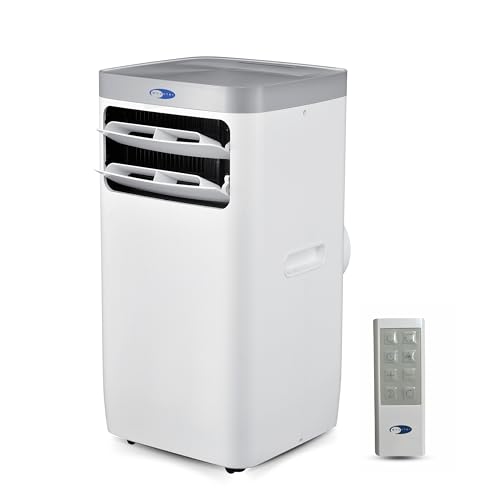
A mid-sized, single-hose portable AC for a bedroom or small living space where a quiet, plug-in unit with simple controls matters more than heat or smart features.
What we like
Whynter lists 11,000 BTU (ASHRAE) and 6,800 BTU (SACC), with coverage up to 400 sq ft
Quiet by the maker's numbers at under 49 dBA on low and under 52 dBA on high, plus an auto drain function and upper and lower drain ports
Casters, a remote, a 24-hour timer, a washable filter and a one-year warranty with three years on the compressor
Drawbacks
Single-hose, cooling-only design with no heat mode and no built-in pump
At 51.25 lb net it is not light, and the 400 sq ft rating is the top of its range
The ARC-115WG is the largest of the three and the only one that publishes noise figures: below 49 dBA on low and below 52 dBA on high. Whynter’s FAQ says most portable units run between 50 and 60 dB, so those numbers are at the quiet end of what the brand describes. For a bedroom, where the unit runs while you sleep, a published figure counts for more than a promise.
Whynter lists 11,000 BTU ASHRAE and 6,800 BTU SACC, with coverage up to 400 sq ft. Use the SACC number. Whynter’s FAQ also says a dual-hose design generally earns a higher SACC for the same ASHRAE rating, so expect this single-hose unit to sit further below its headline. One caution: Whynter’s own page title uses the words dual hose while the specification table describes a single hose. We follow the specification table, so confirm what is in the box.
Drainage is a patented auto drain function, plus upper and lower drain ports. There is no pump, so a hose on the upper port drains by gravity and has to run downhill without kinks. In humid weather the display shows STOP, P1 or FL when the internal tank is full, and Whynter suggests dehumidifier mode with a continuous drain hose or draining the lower port into a shallow pan.
Extras include casters, a digital remote, a 24-hour programmable timer, auto restart and a washable filter. There is no heat mode and no app. The warranty is 1 year, with 3 years on the compressor. At 51.25 lb net it is the heaviest of the three, though casters help.
Best for: a bedroom or den up to 400 sq ft where noise and capacity matter most. Skip it if: the room is tiny, you want an app or you need heat. Specs are in the Whynter ARC-115WG profile.
2. Midea 6,000 BTU Smart Portable AC — The Slim Smart Pick
A slim, smart, DOE-rated portable AC for a small bedroom, office or studio. The two-year warranty and app control set it apart from the basic 5,000 BTU model.
What we like
Midea lists 6,000 BTU on the DOE basis for rooms of 150 to 250 sq ft, so the number is directly comparable to other DOE-rated units
SmartHome app, Apple Watch and voice assistant control, plus a ComfortSense remote that adjusts cooling based on where the remote is
Slim 11.54 x 11.61 x 27.76 inch body with a built-in handle, casters and a washable filter, backed by a two-year warranty
Drawbacks
Cooling, dehumidifying and ventilating only, with no heat mode
At 49.82 lb it is not light, and Midea's page does not publish a noise figure for this model
The Midea MAP06S1JWT-B is the middle step, and it is the model to pick when the room is a small bedroom, home office or studio of 150 to 250 sq ft. Midea lists 6,000 BTU on the DOE basis, so the figure is directly comparable with Whynter’s SACC number: 6,000 against 6,800, which is a modest gap even though the ASHRAE labels differ widely.
Its feature set is the best in the group. Midea lists SmartHome app, Apple Watch and voice assistant control, plus a ComfortSense remote that adjusts cooling strength based on where the remote is. In Midea’s MAP14-series manual, the remote works as a remote thermostat within 26 feet of the unit, so a remote on a nightstand makes the unit regulate toward the bed. Confirm the behavior in the manual that ships with this model. The body is slim, at 11.54 x 11.61 x 27.76 inches, with a built-in handle, casters and a washable filter. The warranty is two years of parts and labor, the longest here on the unit itself.
What Midea’s page does not publish for this model is a noise figure, a hose count or a drain method, so we claim none of them. Midea’s MAP14-series manual describes a bottom tray with a drain outlet and says a P1 code means the tray is full, so keep a shallow pan or hose ready in humid weather. There is no heat mode.
Best for: small bedrooms, offices and studios of 150 to 250 sq ft that want app control and a longer warranty. Skip it if: you need published noise numbers or the room is under 150 sq ft. See the Midea 6,000 BTU Smart Portable AC profile.
3. Midea 5,000 BTU Portable AC — The Simple Dorm-Sized Option
A basic, small-room portable AC for a dorm, nursery-sized bedroom or office. Choose it when 150 sq ft is truly your limit and you do not need apps or heat.
What we like
Midea lists 5,000 BTU on the DOE basis for spaces up to 150 sq ft, aimed at bedrooms, dorms, home offices and workshops
Cool, dehumidify and ventilate functions with a removable, washable filter
Midea says it includes an installation guide and the hardware needed for setup, and the body is 11.54 x 11.61 x 27.76 inches
Drawbacks
No smart control and no heat mode, and the warranty is one year
At 47.4 lb it is not light for such a small unit, and Midea's page does not publish a noise figure
The Midea MAP05R1AWWT-T is the smallest and plainest unit in the lineup. Midea lists 5,000 BTU on the DOE basis for up to 150 sq ft and names bedrooms, home offices, apartments, dorms and workshops as uses. In practice that is a room of roughly 10 x 14 feet or smaller. It has cool, dehumidify and ventilate functions, a removable washable filter, and an installation guide and hardware in the package, according to Midea. There is no smart control and no heat.
It ranks third because it gives the least cooling and the least in the way of features, and the warranty is 1 year. It is the right size for the right room, though. If your room is under 150 sq ft and you do not want an app, a larger unit would cycle more and take more floor space for no gain. Midea shares the same slim 11.54 x 11.61 x 27.76 inch body as the 6,000 BTU model, at 47.4 lb.
As with the 6,000 BTU model, Midea’s page for this unit publishes no noise figure, hose count or drain method. For general guidance we rely on Midea’s manual for its MAP14-series portables, which says to keep at least 20 inches clear around the hose inlet and outlet, to place the unit at least 9.8 inches from the nearest wall, and not to run it in a humid room such as a bathroom or laundry room. Check your dorm’s rules before you buy: some buildings restrict portable air conditioners or limit circuit load.
Best for: dorm rooms, nursery-sized bedrooms and home offices up to 150 sq ft. Skip it if: the room is sunny or larger, or you want an app. Read the Midea 5,000 BTU Portable AC profile.
Our Picks by Use
Bedroom up to 400 sq ft where published noise figures matter:Whynter ARC-115WG.
By budget, the Midea 5,000 BTU model is the entry-level option, the Midea 6,000 BTU model is a step up with smart features, and the Whynter ARC-115WG is the mid-range choice with the most capacity. Check the price on Amazon before you decide.
Conclusion
For a small room, match the DOE or SACC figure to your square footage, then decide how much you care about noise figures, an app and warranty length. The Whynter ARC-115WG is our top pick because it has the most capacity and the only published noise numbers, the Midea 6,000 BTU Smart Portable AC suits compact rooms that want app control, and the Midea 5,000 BTU Portable AC is the basic choice for the smallest spaces. None of the three heats, so if you need heat, or a larger room, see our main portable air conditioner ranking. Whichever you choose, plug it straight into a grounded wall outlet and vent it outdoors.
How many BTUs do I need for a small bedroom or dorm?
Match the DOE or SACC figure to your square footage. Midea rates its 5,000 BTU DOE unit for up to 150 sq ft and its 6,000 BTU DOE unit for 150 to 250 sq ft. Whynter lists 6,800 BTU SACC for the ARC-115WG, with coverage up to 400 sq ft. Sun, high ceilings and electronics push the real need higher, so size toward the larger unit when in doubt.
Is a bigger ASHRAE number better for a small room?
Not by itself. The ASHRAE figure is the older lab rating and does not fully count heat added by the unit or air leaking around the hose. Whynter's ARC-115WG lists 11,000 BTU ASHRAE but 6,800 BTU SACC, so compare the SACC or DOE figures when both are available.
Can a portable air conditioner work in a room without a window?
Every portable air conditioner has to vent hot air outdoors. Whynter's FAQ lists a sliding door kit, a drop-ceiling panel or a wall vent as alternatives to a window. Never vent into another room, a garage or an attic. A wall or ceiling vent is a job for a licensed contractor.
Can I plug a small portable air conditioner into an extension cord in a dorm?
No. Midea's manual says not to use an extension cord or an adaptor plug, and Whynter says to plug directly into a grounded wall outlet, ideally on a dedicated circuit, with no lightweight extension cords, adapters or undersized power strips. If the outlet is not suitable, a licensed electrician should handle it.
Do these small units heat the room?
No. Whynter lists Heat Mode: No for the ARC-115WG, and Midea lists heat as No for both the 6,000 and 5,000 BTU models. If you need heat, see our main ranking, where the Midea Duo 14K with Heat and the EcoFlow Wave 3 list a heating mode.
Which small unit has app control?
The Midea 6,000 BTU Smart Portable AC lists SmartHome app, Apple Watch and voice assistant control. The Midea 5,000 BTU model lists no smart control, and the Whynter ARC-115WG comes with a digital remote and a 24-hour timer but no app.