We earn a commission if you buy through our links, at no extra cost to you.
Best Portable Air Conditioner for Camping, Tents and RVs
Battery-ready portable ACs for tents, vans and campers, plus when a household unit makes sense in an RV on shore power. Power sources, venting and sizing.
At a glance
For camping, pick a unit by its power source. The EcoFlow Wave 3 takes AC or an EcoFlow battery for spaces of 120 to 180 sq ft, the Zero Breeze Mark 3 is a 22 lb 48V spot cooler, and the Whynter ARC-115WG suits an RV on shore power with outdoor venting.


The best portable air conditioner for camping depends on one question: where does the power come from? If you are in a tent, a van or a small camper without a hookup, you need a unit built to run from a battery, and two on this site are: the EcoFlow Wave 3 and the Zero Breeze Mark 3. If you have an RV or camper on shore power, a regular household-style unit such as the Whynter ARC-115WG can work, provided you vent the hot air outdoors and plug it directly into a proper outlet. We did not run any of these units ourselves. Everything below comes from EcoFlow’s, Zero Breeze’s and Whynter’s own pages, manuals and FAQs.
For the whole lineup, including bedroom and living room models, see our ranking of the best portable air conditioners for 2026.
Match the Unit to Your Power Source
Portable air conditioners are not all built the same way. Here is how the three models we cover for camping take power, per the makers:
- EcoFlow Wave 3: EcoFlow’s manual says it supports AC input, and that when it is connected to the WAVE 3 Add-on Battery or other EcoFlow portable power stations, additional power options are available. The XT150 extra-battery port works with the WAVE 3 Add-on Battery, the WAVE 2 Add-on Battery and the DELTA Max, DELTA 2, DELTA 3, DELTA Pro and DELTA Pro 3 families, each with its own cable. EcoFlow notes the compatibility list can change.
- Zero Breeze Mark 3: a 48V DC system (working range 38 to 58.5V). It runs from its detachable 1,022 Wh battery or from a 50V DC power adapter on a wall outlet, which Zero Breeze says lets it run continuously without a battery.
- Whynter ARC-115WG: 115 V, 60 Hz, with a maximum cooling draw of 1,050 W or 9.5 A. It has no battery option.
The takeaway is simple. Check the plug or port before you check anything else. A tent site with no hookup rules out the Whynter. A campground pedestal and an RV rule it in.
Battery Runtime: Plan for Hours, Not a Whole Night
Both battery-ready units publish ranges rather than single numbers, and both say the range depends on conditions. EcoFlow lists a stated 2 to 8 hour run time for the Wave 3 with its 1,024 Wh add-on battery, and its manual says the remaining-time readout may fluctuate while you switch functions. Zero Breeze publishes a table for one 1,022 Wh battery: about 2 to 3 hours in Rocket mode, 3 to 5 hours in Cool mode and 5 to 7 hours in Sleep mode, with Fan mode stretching to 60 to 85 hours. It adds that actual runtime varies with cooling mode, ambient temperature and humidity.
If you want to sleep on battery in hot weather, build in a margin. Zero Breeze says two batteries roughly double each range, and that batteries can be chained so the next one takes over when the first is depleted. Treat the unit’s own readout as an estimate.
Space Size: These Are Spot Coolers
Do not expect a camping unit to cool a large space. EcoFlow’s manual says to use the Wave 3 in a space of about 120 to 180 sq ft for best performance, which fits a tent, a van, a camper bedroom or a small cabin room. Zero Breeze lists 100 to 150 sq ft for the Mark 3, and its “How to Choose” page says it is “designed for personal and small-area cooling” and focuses on spot cooling rather than whole-room cooling. The Whynter ARC-115WG is rated for up to 400 sq ft, and its SACC rating is 6,800 BTU, so it is oversized for a tiny camper. If your camper is small, the smaller units are the better match.
Venting in a Tent, Van or Camper
Every air conditioner moves heat outside, so a camping unit needs a duct to the outdoors too.
- EcoFlow Wave 3: the manual describes insulated exhaust ducts attached to the rear air inlet and outlet, extended outside the window or tent with the openings facing away. EcoFlow says not to overstretch or bend the ducts and not to use them in rain or snow. In the outdoor arrangement, you place the unit outdoors and run the ducts inside. The box includes a pre-cut duct size template that EcoFlow says can be used to make a window vent board for a truck, RV or home window.
- Zero Breeze Mark 3: Zero Breeze says ducts are not required in open spaces, but recommends the rear dual ducts in enclosed places such as tents, vans and boats. Vent kits for windows, tents and boats are sold separately.
- Whynter ARC-115WG: a single 5.5-inch exhaust hose up to 59 inches long and a window kit that adjusts from 20 to 46 inches. Whynter does not recommend extending the hose and says to stay under 9 feet total if it is unavoidable.
Never vent exhaust into another room, a garage or an attic. Anything that involves cutting into a wall, roof or vehicle body, or adding wiring, should go to a licensed contractor or electrician. We do not give steps for that work.
Drainage in the Field
Cooling creates condensate, so plan where the water goes. EcoFlow says to connect the included drain pipe before use, and the no-drain function is not available, so set the drain up before the first night, outside the tent. Zero Breeze describes a micro sensor and an internal pump that drains through the included drainage pipe, and a 10 L condensate collection bag is sold as an accessory. The Whynter ARC-115WG has a patented auto drain function, with upper and lower drain ports and no pump, so drainage depends on gravity or manual draining in humid weather.
EcoFlow Wave 3: The Pick for Flexible AC or Battery Power
A compact cooling and heating unit with an AC input and an XT150 port for the EcoFlow add-on battery or compatible power stations, rated for about 120 to 180 sq ft.
EcoFlow lists 6,100 BTU of cooling and 6,800 BTU of heating, a net weight of 33.7 lb in the U.S. version, a noise range of 44 to 58 dB and an IPX4 rating with an operating temperature of 41 to 122 degrees F. The manual’s box list does not include the battery or a battery cable, so treat both as separate purchases and check what your listing contains. EcoFlow’s pages we read do not state a warranty term, so read its warranty policy before you buy. Details are in our EcoFlow Wave 3 profile.
Zero Breeze Mark 3: The Lightest Battery-First Option
A 22 lb, 48V DC spot cooler with a detachable battery, a wall adapter and an internal drain pump, for tents, trucks and vans up to about 100 to 150 sq ft.
Zero Breeze lists 5,280 BTU of cooling, a supplementary heating mode that it says only works above 50 degrees F ambient, and 46 dB(A) noise. On power, the Mark 3 is a 48V system. Zero Breeze lists 12 to 36V DC only when using a 48V booster, and a 12V to 48V converter is sold separately, so a vehicle’s 12V outlet does not power the unit directly. The battery can also be charged from a 12V vehicle outlet with a cable sold separately, or from solar panels, per Zero Breeze. Several configurations exist, from AC only up to AC plus three batteries, so check what the Amazon listing includes. See the Zero Breeze Mark 3 profile for runtime and venting details.
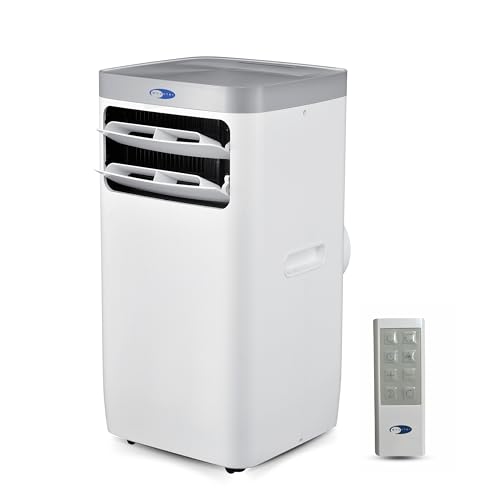
Whynter ARC-115WG: For an RV or Camper on Shore Power
A household-style single-hose portable rated 6,800 BTU SACC for up to 400 sq ft; it needs a 115V outlet and outdoor venting, so it suits an RV or camper with shore power.
Whynter’s FAQ says a portable AC can be used in a garage, server room or RV with proper venting, and that the exhaust must go outdoors with the space reasonably sealed and insulated. For power, Whynter says to plug directly into a properly grounded wall outlet rated for the unit, ideally on a dedicated circuit, with no lightweight extension cords, adapters or undersized power strips. With a 1,050 W maximum draw, sharing a circuit with a microwave or space heater is a common reason for tripped breakers. If you do not have a suitable outlet, Whynter says to consult a licensed electrician. The unit weighs 51.25 lb net, has a noise level under 49 dBA on low, and carries a one-year unit and three-year compressor warranty. See our Whynter ARC-115WG profile.
Quick Decision Guide
- Tent, van or small camper with no hookup, and you already own EcoFlow power gear: EcoFlow Wave 3.
- Lightest option for a tent or truck cab, and you want a detachable battery: Zero Breeze Mark 3.
- RV or camper plugged into shore power: Whynter ARC-115WG, vented outdoors.
Before You Go
Check the plug type, confirm what the listing includes (batteries, cables, vent kits), and test the setup at home before the trip. Measure the opening you plan to vent through, because the kits are not interchangeable between brands. For more models, see the full portable air conditioner ranking.
Sources
Frequently asked questions
Can a portable air conditioner run on a battery while camping?
Only models built for it. EcoFlow says the Wave 3 supports AC input and, through its XT150 extra-battery port, the WAVE 3 Add-on Battery or other compatible EcoFlow power stations. Zero Breeze's Mark 3 is a 48V DC system that runs from its detachable battery or from a 50V DC wall adapter. A household unit such as the Whynter ARC-115WG needs a 115V AC outlet.
How long does a camping air conditioner run on one battery?
It depends on mode and weather. EcoFlow states a 2 to 8 hour run time for the Wave 3 with its 1,024 Wh add-on battery. Zero Breeze lists about 3 to 5 hours in Cool mode and 5 to 7 hours in Sleep mode on one 1,022 Wh battery, and says actual runtime varies with mode, temperature and humidity. Plan for a few hours, not a whole night at a high setting.
Can I run the Zero Breeze Mark 3 from my car's 12V outlet?
Not directly. Zero Breeze says the unit is a 48V system and lists 12 to 36V DC only when using a 48V booster. A 12V to 48V converter is sold separately. Follow Zero Breeze's manual for every cable and connector.
Do camping air conditioners still need to be vented?
Yes. The EcoFlow Wave 3 uses insulated exhaust ducts that go outside the window or tent opening, and Zero Breeze recommends rear dual ducts in enclosed places such as tents, vans and boats. Never vent exhaust into another room, a garage or an attic.
Can I use a regular portable air conditioner in an RV?
Whynter's FAQ says a portable AC can be used in a garage, server room or RV with proper venting, as long as the exhaust goes outdoors and the space is reasonably sealed and insulated. That means a 115V outlet on shore power. Whynter says to plug directly into a properly grounded wall outlet and not to use lightweight extension cords, adapters or undersized power strips. Have a licensed electrician check any wiring questions.
How big a space can a camping air conditioner cool?
Less than a bedroom unit. EcoFlow's manual says to use the Wave 3 in a space of about 120 to 180 sq ft for best performance, and Zero Breeze lists 100 to 150 sq ft for the Mark 3 and calls it designed for personal and small-area cooling.