We earn a commission if you buy through our links, at no extra cost to you.
Comparison
Best Portable Air Conditioners of 2026: 7 Top Picks
Seven portable air conditioners ranked for 2026, from a heating inverter to battery-ready units, with DOE and SACC figures, room sizes and hose types.
B By the Best Portable Air Conditioners editorial team ·Published
At a glance
For a large room, choose the Midea Duo 14K with Heat, a hose-in-hose inverter unit that also heats. The Whynter NEX ARC-1280MX brings dual hoses at 55 lbs, and the Dreo 740S is a dual-hose inverter listed as low as 42 dBA. For tents and vans, the EcoFlow Wave 3 is battery-ready.
A portable air conditioner is the answer when a window unit will not fit, a landlord says no, or a single room runs hotter than the rest of the house. It is also the product where the numbers on the box are easiest to misread. A “14,000 BTU” label can describe a machine that delivers far less cooling in a real room, and a “no drain” claim usually has a humidity condition attached. This ranking covers the seven portable air conditioners on our site, from large-room inverters to two battery-ready units for tents, vans and campers, and it sticks to what each maker publishes. We compared specs and did not run the units ourselves. If your room is a dorm or a small bedroom, see our separate ranking of small portable air conditioners.
How We Chose
We ranked these seven on five things, in this order.
A cooling figure you can compare. Portable air conditioners carry two kinds of BTU ratings. The older ASHRAE number is a lab figure that does not fully count the heat the unit adds to the room or the warm air that leaks in around the hose. SACC, the seasonally adjusted cooling capacity from the Department of Energy’s portable air conditioner procedure, counts those losses, and “DOE BTU” on a spec page generally means the same basis. Whynter’s FAQ gives the standard example: a unit labeled 14,000 BTU on the old basis can come out at 8,500 to 10,000 BTU SACC, which is a more honest label, not a weaker machine. When a maker gives a SACC or DOE figure, we lead with it. When it does not, we say so.
Room size. We use each maker’s own square-footage claim. Treat it as a ceiling for a shaded, well-insulated room. Sun-facing rooms, high ceilings and kitchens call for a margin.
Single hose or dual hose. A single-hose unit exhausts room air outdoors and pulls replacement air in through gaps. A dual-hose unit draws outdoor air for the hot side through a second hose. Whynter’s FAQ says dual-hose units cool faster and help maintain room pressure, and that a dual-hose design generally earns a higher SACC for the same ASHRAE rating.
Inverter or fixed speed. An inverter compressor slows down as the room nears the set temperature instead of cycling fully on and off. That usually means steadier temperatures and less abrupt noise. We use only the noise figures makers publish, and where a maker publishes only a best-case number we say so.
Drainage and extras. Whether it evaporates condensate, what happens in humid weather, and whether it heats.
Because this is the main ranking, the top of the list goes to the largest, most capable models. The two battery-ready units sit at the bottom because they cool much smaller spaces and solve a different problem.
Outlet and venting rules. Plug any portable air conditioner directly into a properly grounded wall outlet. Midea’s manual says not to use an extension cord or an adaptor, and Whynter says to avoid lightweight extension cords, adapters and undersized power strips and to use a dedicated circuit where possible. For Dreo, EcoFlow and Zero Breeze, follow the power instructions in the manual. If you do not have a suitable outlet, have a licensed electrician add one. Vent outdoors only: Whynter’s FAQ says never to vent into another room, a garage or an attic, and any wall or ceiling vent is a job for a licensed contractor. We give no installation steps for wiring or ducting.
Summary Table
#
Model
DOE / SACC BTU
Maker’s other figure
Room size (maker)
Hose
Heat
Noise (maker)
Warranty (maker)
1
Midea Duo 14K with Heat
12,000 DOE
”14K” name echoes older rating
Up to 550 sq ft
Hose-in-hose (one assembly)
Yes
As low as 42 dBA
1 year
2
Whynter NEX ARC-1280MX
10,000 SACC
13,000 ASHRAE
Up to 500 sq ft
Dual
No
50 to 56 dBA
1 year, 3 years on compressor
3
Dreo 740S
10,000 DOE
14,000 ASHRAE
Up to 400 sq ft
Dual
No
As low as 42 dBA
12 months
4
Whynter ARC-14S
9,500 SACC
14,000 ASHRAE
Up to 500 sq ft
Dual
No
Below 51 to below 56 dBA
1 year, 3 years on compressor
5
Dreo AC515S
Not published
12,000 ASHRAE
Up to 300 sq ft
Single
No
46 dB
12 months
6
EcoFlow Wave 3
Not labeled
6,100 cooling, 6,800 heating
120 to 180 sq ft
Ducts to outdoors
Yes
44 to 58 dB
Not stated on pages we read
7
Zero Breeze Mark 3
Not labeled
5,280 cooling, 5,800 heating
100 to 150 sq ft
Dual
Yes (supplementary)
46 dB(A)
1 year
1. Midea Duo 14K with Heat — The Large-Room Pick That Also Heats
A large-room, quiet-leaning portable for people who want one box that also heats in mild weather. The hose-in-hose layout keeps setup to a single window connection, but plan for the weight and the drain hose in heat mode.
What we like
Midea lists 12,000 BTU on the DOE basis for rooms up to 550 sq ft, with an inverter compressor and a hose-in-hose design
Four modes in one unit: cool, heat, fan and dehumidify, with app, Apple Watch and voice-assistant control
Midea lists noise as low as 42 dBA and includes a window kit, four wheels and a washable filter
Drawbacks
At 77.16 lbs it is one of the heavier portables, and Midea's page lists a 1-year warranty
Heat mode works as a heat pump and the manual says the drain hose must be installed while it runs, so it is not a bucket-free winter setup
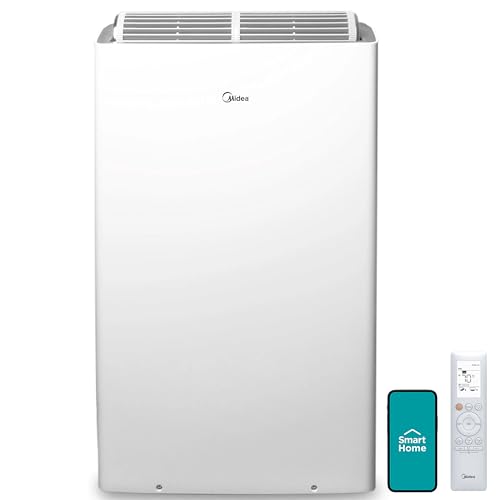
The Midea Duo earns the top spot because it combines the largest room rating in the group with the DOE-basis number up front. Midea says 12,000 BTU DOE for spaces up to 550 sq ft, an inverter compressor it says saves over 40 percent energy compared with the federal standard, and a lowest noise level of 42 dBA. The “14K” in the name echoes the older rating, so size by 12,000. The hose-in-hose design puts the exhaust and the cool-air intake in one flexible assembly, which gives you much of a dual-hose layout with a single window connection.
The heat mode is the other differentiator. The Duo is a heat pump, and Midea’s manual gives a heating range of 41 to 86 degrees F. That makes it useful in spring and fall, not a furnace replacement. The manual also says the included drain hose must be installed while it heats, and the unit has a condensate pump so the hose can rise up to 6 ft.
The costs are real. It weighs 77.16 lbs, Midea publishes only the 42 dBA best case, and the warranty is 1 year. Midea’s manual says no extension cord or adaptor, so plan the outlet before you buy.
Best for: big living rooms, open plans and people who want one unit for cooling and mild-weather heat. Skip it if: you need something light, or you only want cooling. Specs are in the Midea Duo 14K with Heat profile.
2. Whynter NEX ARC-1280MX — The Smart Dual-Hose Inverter
A mid-size, smart, dual-hose inverter for living rooms and bigger bedrooms. Strong specs on paper; check your window width against the 82 inch kit before buying.
What we like
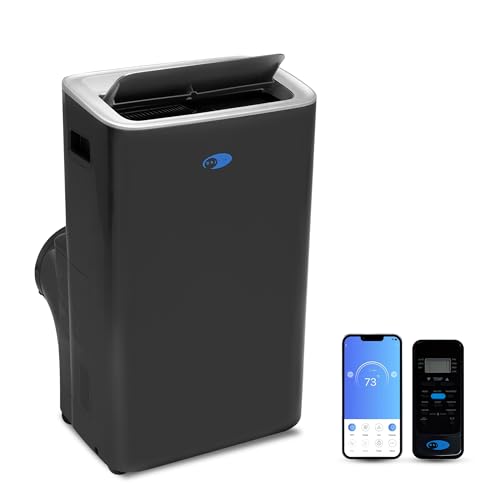
Whynter lists 13,000 BTU ASHRAE and 10,000 BTU SACC with a dual-hose NEX inverter, for rooms up to 500 sq ft
Smart control through the NetHome Plus app, Alexa, Google Home and Apple Siri, plus a 24-hour timer and sleep mode
Upper and lower drain ports, self-evaporation, and a listed net weight of 55 lbs
Drawbacks
Cooling only: Whynter lists no heat mode
Whynter lists 50 to 56 dBA, which is not especially quiet, and the warranty is 1 year on the unit and 3 years on the compressor
Whynter lists 13,000 BTU ASHRAE and 10,000 BTU SACC, which is a strong SACC figure for a unit this size, and it comes with a true dual-hose layout. Coverage is up to 500 sq ft. It is a cooling-only product by Whynter’s spec table, but it adds a NetHome Plus app, Alexa, Google Home and Apple Siri control, a 24-hour timer and sleep mode, and a CEER of 12.1.
Drainage is flexible: self-evaporation, a lower drain port and an upper gravity drain port for a continuous hose in humid weather. The net weight of 55 lbs is much lighter than the Midea Duo’s 77 lbs, which matters if you move it between rooms or up stairs. Where it gives ground is noise. Whynter lists 50, 53 and 56 dBA without saying which speed each belongs to, so it is not the pick for the lightest sleepers. The warranty is 1 year, with 3 years on the compressor.
Measure the window first: the kit adjusts up to 82 inches. Whynter says to plug directly into a grounded wall outlet, ideally on a dedicated circuit.
Best for: 300 to 500 sq ft rooms where weight, smart control and a compressor warranty matter. Skip it if: you want heat or the quietest figure. See the Whynter NEX ARC-1280MX profile.
3. Dreo 740S — The Quiet-Leaning, Mostly Drain-Free Inverter
A quiet-leaning, app-controlled dual-hose inverter for living rooms and large bedrooms that mostly skips the drain bucket. Check your window height against Dreo's 20 to 53 inch range first.
What we like
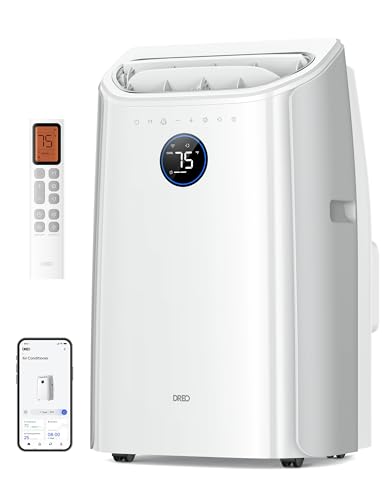
Dreo lists 10,000 BTU DOE (14,000 BTU ASHRAE) for rooms up to 400 sq ft, with an inverter and a dual-hose, dual-motor design
Dreo says it is drainage-free in environments below 90 percent humidity, so there is normally no tank to empty
Dreo lists a lowest noise level of 42 dBA, app, remote and voice control through Alexa and Google Assistant, and a CEER of 12
Drawbacks
Cooling only, with no heat mode in Dreo's list of modes
Dreo's page does not publish a weight, and the warranty is 12 months
A dual-hose, dual-motor inverter that Dreo lists at 10,000 BTU DOE for up to 400 sq ft, with a lowest noise level of 42 dBA and drainage-free operation below 90 percent humidity.
Dreo gives both numbers, 14,000 BTU ASHRAE and 10,000 BTU DOE, and the second is the one to use. Its 400 sq ft rating is a step below the Whynter and Midea units above, which is why it ranks third, but it matches the NEX on the DOE figure and adds a quiet headline. Dreo’s lowest noise level is 42 dBA, and its page publishes nothing for higher fan speeds, so treat that as the best case.
The standout feature is the drainage claim. Dreo says “Real Drainage-Free in Environments Below 90% Humidity,” so in most conditions there is no tank to empty. Above that humidity, Dreo’s FAQ says a P1 code means the tray is full, and a drain hose is in the box for a continuous run. App, remote and touch-panel control are included, with Alexa and Google Assistant voice control and a CEER of 12.
Dreo’s page does not publish a weight, which makes comparing it with the Whynter units harder. It does not list a heat mode, and the warranty is 12 months. Check your window height against Dreo’s 20 to 53 inch range.
Best for: large bedrooms and living rooms up to 400 sq ft where a quiet-leaning, low-maintenance drain matters. Skip it if: you need heat or a published weight. Read the Dreo 740S profile.
4. Whynter ARC-14S — The No-Frills Fixed-Speed Workhorse
A long-running, no-frills dual-hose workhorse for big rooms that skips smart features and the inverter. A fit if you want proven basics and a compressor warranty more than a quiet, app-driven unit.
What we like
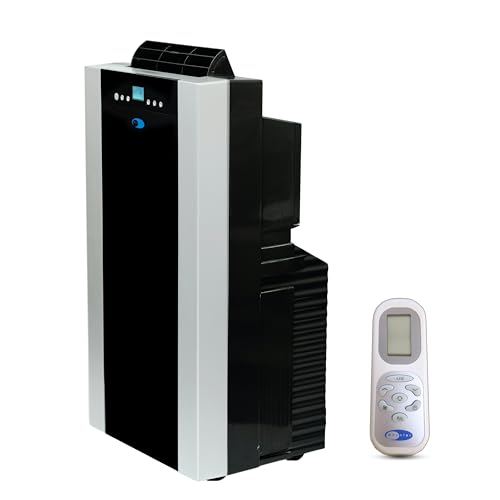
Whynter lists 14,000 BTU ASHRAE and 9,500 BTU SACC with dual hoses, for spaces up to 500 sq ft
Patented auto drain that Whynter says exhausts condensate automatically in most environments, plus cool, fan and dehumidifier modes and a 24-hour timer
Activated carbon filter with a washable pre-filter, an LCDI plug, auto-restart and a 3-year compressor warranty
Drawbacks
Fixed-speed rather than inverter, with Whynter listing 51 dBA on low and 56 dBA on high
At 73 lbs net with no heat mode, no upper gravity drain port and no app listed on the page
The ARC-14S is the oldest design here, and it shows in the specs: Whynter lists 14,000 BTU ASHRAE but only 9,500 BTU SACC, and it is not an inverter. A fixed-speed compressor runs at full output and shuts off when the room reaches the setting, which is part of why Whynter’s noise figures are below 51 dBA on low and below 56 dBA on high. It also weighs 73 lbs net.
What you get in return is simplicity. Whynter lists a patented auto drain, an activated carbon filter plus a washable pre-filter, a 24-hour timer, auto restart and an LCDI plug. The coverage claim is 500 sq ft, and the 3-year compressor warranty is the same as on the NEX. There is no heat mode, no upper gravity drain port and no app listed on the page.
It ranks fourth because the NEX offers a higher SACC with an inverter at a lower weight. It is still a sensible choice for buyers who want proven basics and no smart features.
Best for: large rooms and open floor plans under 500 sq ft where simple controls win. Skip it if: you want an inverter, an app or a lighter unit. Details are in the Whynter ARC-14S profile.
5. Dreo AC515S — The Single-Hose Smart Unit for Bedrooms
A smart, quiet-leaning single-hose unit for a bedroom or small living room up to about 300 sq ft. Size it conservatively, since the page shows only the ASHRAE rating.
What we like
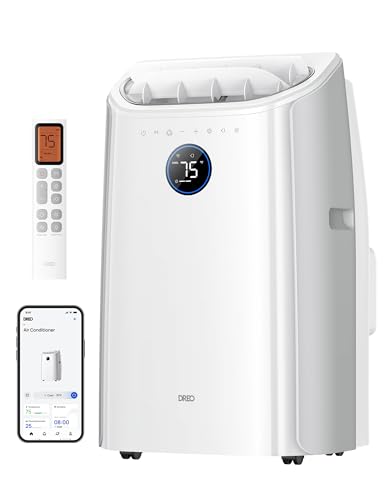
Dreo lists 12,000 BTU (ASHRAE 128) for floor areas up to 300 sq ft, with cool, dry and fan modes
Dreo says its auto-drain, self-evaporating system expels condensate when humidity is below 85 percent, so there is normally no tank to empty
App and voice control, a 46 dB noise figure and a universal window kit for 17 to 53 inch windows
Drawbacks
Single-hose design, so it is less efficient in big or sunny rooms than a dual-hose unit, and Dreo's page gives no DOE or SACC figure
No heating function, and the warranty is 12 months
A single-hose smart portable that Dreo lists at 12,000 BTU ASHRAE for up to 300 sq ft, with a 46 dB noise figure and auto-drain below 85 percent humidity.
The AC515S is the one model in the large-room ranking where you have to read the number carefully. Dreo’s page gives 12,000 BTU on the ASHRAE 128 basis and does not publish a DOE or SACC figure, so we do not make one up. Whynter’s FAQ says single-hose designs generally score a lower SACC for the same ASHRAE rating, so size the room with margin. Dreo lists a 300 sq ft floor area, which fits a bedroom or home office.
What it does well is stay out of the way. Dreo’s patented auto-drain system expels condensate when humidity is below 85 percent, there is an app and voice control, and the noise figure is 46 dB. The universal window kit covers windows from 17 to 53 inches. Dreo’s FAQ says it has no heating function, the warranty is 12 months and the page lists no weight. Dreo also sells an optional dual-hose kit compatible with the 515S, 516S and 740S, which is a sold-separately accessory.
Best for: bedrooms and small living rooms up to about 300 sq ft. Skip it if: the room is big or sunny. See the Dreo AC515S profile.
6. EcoFlow Wave 3 — The Battery-Ready Pick for Tents, Vans and Campers
A compact, battery-ready portable AC and heater for small spaces such as a tent, van, camper or small room. Plan on buying the battery side separately if you want to run off-grid.
What we like
EcoFlow lists 6,100 BTU of cooling and 6,800 BTU of heating from a 33.7 lb unit
Runs from a wall outlet, and an XT150 port accepts the WAVE 3 Add-on Battery or compatible EcoFlow power stations
Built-in condensate pump with an included drain pipe, app control and a published 44 to 58 dB range
Drawbacks
The Add-on Battery and its cable are separate EcoFlow products, and EcoFlow's 2 to 8 hour run time covers a wide range of conditions
EcoFlow recommends a space of 120 to 180 sq ft, so it is a small-space unit, and it needs ducts routed outside
A 33.7 lb portable AC and heater with an AC cord and an XT150 port for the WAVE 3 Add-on Battery or compatible EcoFlow power stations, for small spaces.
The Wave 3 does not belong in the same contest as the models above, and EcoFlow does not pretend otherwise: it recommends a space of 120 to 180 sq ft. EcoFlow lists 6,100 BTU of cooling and 6,800 BTU of heating without naming the rating basis, so do not compare those figures directly with a SACC-rated household unit.
What it offers instead is a second power path. It plugs into a wall outlet, and according to EcoFlow’s manual an XT150 extra-battery port connects the WAVE 3 Add-on Battery or other compatible EcoFlow power stations. EcoFlow’s specs page lists a 2 to 8 hour run time with its Add-on Battery, a range that depends on mode and conditions. The battery and its cable are separate products, so check your listing. Other listed details are a built-in condensate pump with an included drain pipe, an IPX4 weather rating, a 44 to 58 dB noise range and app control. The pages we read do not state a warranty term, so read EcoFlow’s warranty policy before buying. For off-grid use, follow the manual’s power and venting instructions.
Best for: tents, vans, campers and small nooks where power is the constraint. Skip it if: you need to cool a bedroom or living room. Specs are in the EcoFlow Wave 3 profile.
7. Zero Breeze Mark 3 — The Lightest Battery-Ready Option
A very light, battery-first portable AC for tents, vans, trucks and small campers. Treat it as personal spot cooling and not as a bedroom AC replacement.
What we like
Zero Breeze lists 5,280 BTU of cooling, a heating mode and a weight of about 22 lb
Runs on a 48V DC battery or a wall outlet through the 50V DC adapter, with a built-in drain pump
Dual-hose design, 46 dB(A) listed noise and a 1,022 Wh detachable Mark 3 battery that can be stacked
Drawbacks
Zero Breeze rates it for 100 to 150 sq ft and calls it spot cooling for small areas, not whole-room cooling
Battery runtime is a range that depends on mode and conditions, and the battery and venting kits are separate items
A 22 lb dual-hose spot cooler that Zero Breeze lists at 5,280 BTU of cooling, running from a 48V DC battery or a 50V DC wall adapter, for 100 to 150 sq ft.
The Mark 3 is the smallest and lightest unit in the ranking: 22 lbs and 22 x 10 x 12 inches, per Zero Breeze. It is a 48V DC system. It runs from a detachable Mark 3 battery or from a wall outlet through the 50V DC adapter, and Zero Breeze says 12 to 36V DC sources work only through a 48V booster or a 12V-to-48V converter sold separately. Cooling input is rated at 500 W.
Zero Breeze describes it as designed for personal and small-area cooling, with a coverage claim of 100 to 150 sq ft. It lists a dual-hose design, 46 dB(A) noise, supplementary heating that works above 50 degrees F ambient, a 1-year warranty and a 30-day return policy. The product page sells several bundle configurations, so check what your Amazon listing includes for batteries, adapters and vent kits.
It ranks last because it covers the least area, not because it is poorly made. For a tent or a camper where weight and power budget decide everything, it is the lightest option here.
Best for: camping, trucks and spot cooling where every pound counts. Skip it if: you want whole-room cooling. See the Zero Breeze Mark 3 profile.
By budget, the Whynter ARC-14S and Dreo AC515S sit toward the entry and mid-range end of this group, the Midea Duo and Whynter NEX sit higher, and the battery-ready units sit apart because the battery is sold separately. Check the price on Amazon before you decide, and for a small room look at our small portable air conditioner ranking.
Conclusion
Start with the room, not the label. Take the DOE or SACC figure, match it to your square footage with a margin for sun and ceiling height, then choose between one hose and two, inverter and fixed speed, and a drain plan that fits your climate. The Midea Duo 14K with Heat is our top pick for large rooms because it pairs the highest room rating with an inverter and a heat mode, the Whynter NEX ARC-1280MX and Dreo 740S follow as the best-spec dual-hose inverters, and the EcoFlow Wave 3 and Zero Breeze Mark 3 serve the off-grid niche. Whatever you buy, plug it directly into a grounded wall outlet and vent it outdoors only.
Which BTU number should I use to size a portable air conditioner?
Use the DOE or SACC figure when the maker gives one. It counts heat the unit adds and air that leaks back in, so it is closer to what the room actually gets. Midea lists 12,000 BTU DOE for the Duo, Whynter lists 10,000 SACC for the NEX ARC-1280MX, and Dreo lists 10,000 DOE for the 740S. The larger ASHRAE numbers are real labels but flatter every portable.
Is a dual-hose portable air conditioner better than a single-hose one?
Whynter's FAQ says dual-hose units cool faster and help maintain room pressure, while single-hose units are simpler to set up and less efficient in large or sunny rooms. In a small, shaded bedroom the gap is smaller. Midea's Duo uses a hose-in-hose design that puts both air paths in one hose assembly.
Can I plug a portable air conditioner into an extension cord?
Not for the models with a published rule. Midea's manual says not to use an extension cord or an adaptor, and Whynter says to plug into a properly grounded wall outlet, ideally on a dedicated circuit, with no lightweight extension cords, adapters or undersized power strips. For Dreo, EcoFlow and Zero Breeze, follow the power instructions in the manual. A licensed electrician should add or fix an outlet.
Can I vent a portable air conditioner into a garage, attic or another room?
No. Whynter's FAQ says to vent outdoors, because venting into another room, a garage or an attic pushes heat and moisture into that space. Any wall vent or ceiling plenum is a job for a licensed contractor.
Which portable air conditioner can run on a battery?
The EcoFlow Wave 3 has an XT150 extra-battery port for the WAVE 3 Add-on Battery or compatible EcoFlow power stations, and the Zero Breeze Mark 3 runs from a 48V DC battery or a 50V DC wall adapter. Both makers sell the battery side separately, so check what your listing includes.
Do I have to empty a water tank?
It depends on the model and the humidity. Dreo says the 740S is drainage-free below 90 percent humidity and the AC515S expels condensate below 85 percent humidity. Whynter's models use auto drain or self-evaporation, with drain ports for humid weather. Midea's Duo needs the included drain hose in heat mode. Every maker describes a full-tray code, so plan for a drain hose in humid climates.