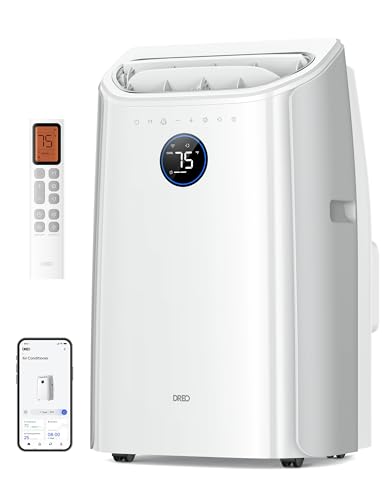
The Dreo 740S is a dual-hose portable air conditioner with an inverter compressor, rated by Dreo at 10,000 BTU on the DOE basis and 14,000 BTU on the ASHRAE basis. Dreo says it covers rooms up to 400 sq ft, runs as quietly as 42 dBA and does not need a drain in environments below 90 percent humidity. This profile walks through what Dreo publishes, how to read the BTU numbers, how drainage and venting work, and who should buy it or look elsewhere. Specs come from Dreo’s product page. We did not run the unit ourselves.
What Dreo Says About the 740S
According to Dreo’s specification table:
- Capacity: 10,000 BTU (DOE) and 14,000 BTU (ASHRAE).
- Coverage: up to 400 sq ft.
- Compressor: inverter. Hose configuration: dual hose. Motor type: dual motor.
- Power: 115 volts, 1,500 watts, corded.
- Efficiency: CEER of 12. Refrigerant is R32.
- Noise: lowest noise level 42 dBA.
- Airflow: 235 CFM, with an airflow distance of 19.7 ft and 60 to 90 degrees of vertical auto swing.
- Modes: cool, dry, fan and sleep. The temperature range for cooling is 61 to 86 degrees F.
- Dehumidification: 112 pints per day, as listed by Dreo.
- Controls: app, touch panel and remote control, with voice control through Alexa and Google Assistant. Timer: 24 hours in the app and 12 hours on the control panel.
- Size: 14.37 inches deep, 17.32 inches wide, 28.11 inches high. Dreo’s page does not list a weight.
- Mobility: caster wheels.
- Window fit: window heights from 20 to 53 inches.
- Accessories: a universal window kit with four panels, two exhaust hoses of 5 ft each, a drain hose, a remote and two batteries.
- Warranty: 12 months against material defects and workmanship.
The page’s own summary describes it as having “adaptive inverter tech” and a dual-hose design for faster, more efficient cooling.
DOE BTU vs ASHRAE BTU
Two numbers on one label confuse a lot of shoppers. The ASHRAE rating is the older, more generous one; it does not count the heat a portable AC adds to the room or the warm air pulled in to replace what leaves through the exhaust hose. The DOE rating, often called SACC, is stricter and closer to what you actually feel. Dreo gives both, which is helpful: use 10,000 BTU when you size a room and when you compare with another portable, and treat 14,000 as the marketing-friendly number. Whynter, another maker we cover, notes that a dual-hose design generally gets a higher SACC for the same ASHRAE rating. The same logic runs through our portable air conditioner ranking.
Dual Hose and Inverter
A dual-hose design uses one hose to bring outside air in for the hot side of the system and another to exhaust it, instead of heating room air and throwing it out the window. That avoids creating a slight vacuum that pulls hot outdoor air in through gaps. The 740S ships with two 5 ft hoses, so the unit needs to sit within about that distance of the window panel. Keep both hoses short and unkinked.
An inverter changes the compressor’s speed rather than switching it fully on and off. In practice that means a steadier room temperature and, on paper, lower noise once the room is at target. Dreo’s 42 dBA figure is the lowest noise level, so it is a best case, not a rating for every mode. Dreo’s page does not publish noise at higher fan speeds, so if you are a light sleeper in a hot room, plan on hearing more than 42 dBA when the unit is working hard.
Drainage
Most portables collect condensate in a tray and either evaporate it through the exhaust or need you to empty it. Dreo’s spec says “Real Drainage-Free in Environments Below 90% Humidity.” That is a conditional claim: below that humidity the unit is designed to handle condensate itself, and above it the tray may fill. Dreo’s FAQ says a P1 code means the water collection tray is full; turn the unit off, drain it and restart. A drain hose is included, so a continuous run to a floor drain is possible for humid climates or basement use.
Dreo’s FAQ also covers a few other behaviors worth knowing. A gurgling sound is described as normal and caused by refrigerant flow. If ice forms on the cooling coil behind the air outlet, the room may be below 60 degrees F or the filter may be dirty; Dreo says to switch to fan-only mode and clean the filter. E0, E1 or E2 error codes mean you should contact customer service.
Setup Tips
- Check your window first. Dreo lists fit for window heights of 20 to 53 inches. A tall sliding window may need extra care sealing the panels.
- Seal the gaps. The kit has four panels and foam. Most cooling complaints on any portable come from leaks at the window, hose connections or doorway, not from the compressor.
- Place it level and close to the window. Dreo says to use a flat, level surface if the unit vibrates or is noisy.
- Clean the filter. A blocked filter is Dreo’s first suggestion when the unit is not cooling well or is noisy.
- Power. Follow the power instructions in Dreo’s manual. Dreo’s FAQ says to make sure the plug is firmly in the outlet and to press the RESET button if the plug’s current device has tripped. Do not run it from a lightweight extension cord. Any new outlet, circuit or wall vent is a job for a licensed electrician or contractor, and this profile gives no steps for that work. Never exhaust the hose into another room, a garage or an attic.
- Use the app. Dreo’s spec lists app control, a 24-hour timer in the app and voice assistants, so you can set the unit to shut off at a set time.
Where It Falls Short
- No heat mode. Dreo lists cool, dry, fan and sleep only.
- Weight is not published. For a unit with a dual-hose layout and a big window kit, that matters if you move it up stairs.
- Drainage-free has a limit. Above 90 percent humidity you still have to manage water.
- Short warranty. Dreo’s term is 12 months, shorter than the compressor coverage some brands offer.
- Window kit fit. Panels have to be cut or sealed for odd windows, and casement windows need a different solution.
Who It Suits
- Owners of a 200 to 400 sq ft living room or large bedroom who want a dual-hose inverter with app and voice control.
- Buyers who dislike emptying tanks and live where humidity usually stays below 90 percent.
- People already using Dreo fans or humidifiers who want one app.
- Anyone comparing it with the Midea Duo 14K with Heat and who does not need heating.
Who Should Look Elsewhere
- Buyers who need heat should look at the Midea Duo 14K with Heat, which has a heat pump mode.
- Small rooms and tight budgets may be better served by the Dreo AC515S, a single-hose 12,000 BTU (ASHRAE) unit that Dreo lists for 300 sq ft.
- Very humid climates where the room regularly stays above 90 percent humidity should plan for continuous draining, whichever brand they choose.
Bottom Line
The Dreo 740S is a dual-hose, inverter-driven portable with a published DOE rating, a low-noise figure, app control and a drainage-free design with a humidity caveat. Size it by the 10,000 BTU DOE figure, measure your window and confirm the power instructions in the manual. For the full set of models, see our portable air conditioner ranking for 2026.
See price on Amazon
Sources