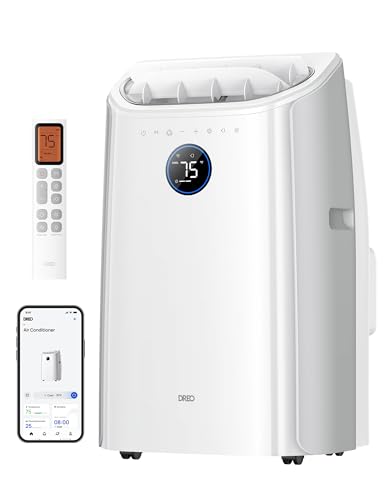
The Dreo AC515S is a smart, single-hose portable air conditioner designed for bedrooms and smaller living spaces. Dreo lists it at 12,000 BTU on the ASHRAE 128 basis, with a floor area of 300 sq ft, a noise figure of 46 dB, and app and voice control. It also promotes an auto-drain system that is meant to spare you a tank in most conditions. This profile covers what Dreo publishes, why the BTU number needs a caveat, how drainage and venting work, and who should buy it. Specs come from Dreo’s product page and FAQ. We did not run the unit ourselves.
What Dreo Says About the AC515S
According to Dreo’s product page:
- Cooling power: 12,000 BTU, ASHRAE 128.
- Floor area: 300 sq ft.
- Noise: 46 dB.
- Modes: 3-in-1, cool, dry and fan. The FAQ says there is no heating function.
- Hose design: single hose. The FAQ states it is not a dual-hose or Twincool unit.
- Window kit: a universal window kit and hose for windows 17 to 53 inches, per the page’s feature list. The FAQ gives the standard range as a minimum of 18 inches and a maximum of 53 inches, and says the hose can go in a vertical or horizontal sliding window.
- Control: smart app and voice control, plus a remote that works within 26 feet of the unit, preferably at an angle of less than 45 degrees.
- Power: 120 volts, corded, with a power cord of about 5.9 ft (1.8 m). Refrigerant is R-32.
- Size: 14.37 inches deep, 17.32 inches wide and 28.13 inches high. The page lists no weight.
- In the box: one universal window kit and hose, one remote control and the air conditioner.
- Colors: white and black, per the product page.
- Warranty: 12 months against material defects and workmanship for new Dreo products.
Dreo also sells a sibling, the AC516S. According to Dreo’s FAQ, the two have the same functions and differ only in cooling capacity: 12,000 BTU for the AC515S and 14,000 BTU for the AC516S, both on the ASHRAE 128 basis.
The BTU Number Needs a Caveat
Portable air conditioners are labeled two ways. The ASHRAE figure is the older, more generous one, because it does not fully account for the heat the unit adds to the room or the warm air that leaks in to replace what the exhaust hose carries outside. The Department of Energy’s SACC figure, sometimes shown as “DOE BTU,” counts those losses and is much closer to real-world cooling. Whynter’s FAQ explains that a unit rated 14,000 BTU on the old basis might come out at only 8,500 to 10,000 BTU on the SACC basis, and that a dual-hose design generally scores a higher SACC for the same ASHRAE rating.
Dreo’s product page for the AC515S gives only the ASHRAE number. By contrast, the page for the dual-hose Dreo 740S lists both 14,000 BTU ASHRAE and 10,000 BTU DOE. Whynter notes that single-hose designs generally score a lower SACC for the same ASHRAE rating, so size the room with margin. We do not give a SACC figure for the AC515S because Dreo’s page we read does not publish one. See our portable air conditioner ranking for how we compare models on a consistent basis.
Single Hose, in Practice
A single-hose portable pulls air from the room, uses it to cool its hot coil and then exhausts that air outside. The room then draws replacement air in through gaps around doors and windows. Whynter’s FAQ puts it plainly: single-hose units have a simpler setup and are less efficient in large or sunny rooms, while dual-hose units cool faster and help maintain room pressure. For a bedroom of modest size with the door closed, the difference is smaller. For an open-plan space or a room with big west-facing windows, a dual-hose model such as the Whynter ARC-14S or the Dreo 740S is the more natural choice.
Drainage
Dreo’s FAQ says condensation during cooling is minimal. The water is sent by a pumping motor to the condenser, where it evaporates. Dreo’s patented auto-drain, or self-evaporating, technology expels condensation automatically when humidity is below 85 percent. The product page markets this as a drainage-free system. Above that humidity level the unit can build up water: a P1 protection code means the water collection tray is full, and Dreo’s instruction is to turn the air conditioner off, drain the tray and restart.
The box lists no separate drain hose, so if you live in a humid area, plan how you would handle a full tray before you buy.
Setup Tips
- Measure the window. The kit is listed for 17 to 53 inches on the page, and 18 to 53 inches in the FAQ. Use the narrower range to be safe.
- Seal the panels. Gaps around the window kit let hot air in and reduce the real cooling you get.
- Keep it level. Dreo says to place the unit on a flat, level surface if it is noisy or vibrating, and to clean the filter.
- Clean the filter. Dreo’s FAQ suggests cleaning the filter if the unit is not cooling effectively.
- Check the hose. If cooling is poor, Dreo says to turn off the unit, disconnect the vent hose, check for blockage and reconnect it.
- Mind the coil. If ice forms on the cooling coil behind the air outlet, Dreo says to switch to fan-only mode if the room is below 60 degrees F and to check the filter.
- Power. Dreo’s FAQ says the unit is for a nominal 120 V circuit and should go into a grounding outlet. Follow the power instructions in Dreo’s manual, and do not use a lightweight extension cord. Any new outlet, circuit or wall vent is a job for a licensed electrician or contractor, and this profile gives no steps for that work. Never exhaust the hose into another room, a garage or an attic.
Where It Falls Short
- Single hose. It will lose more capacity than a dual-hose unit at the same ASHRAE rating.
- No DOE or SACC figure on the page we read, so comparing it with other models takes extra care.
- No heat. Dreo says so directly.
- Weight not published. Check the manual or packaging before you carry it upstairs.
- Drainage depends on humidity. The auto-drain works below 85 percent humidity, per Dreo.
- Short warranty. Dreo’s term is 12 months.
Who It Suits
- Bedrooms and home offices of roughly 150 to 300 sq ft where a smart, relatively quiet portable is the goal.
- Buyers already using the Dreo app for fans or humidifiers.
- People who prefer a single hose connection and a simple window kit.
- Shoppers who want a lower-capacity Dreo than the 740S.
Who Should Look Elsewhere
- Large or sunny rooms are better served by dual-hose models such as the Dreo 740S, which Dreo lists at 10,000 BTU DOE for up to 400 sq ft.
- People who want a rated SACC figure on the page can look at the Whynter ARC-14S, which Whynter lists at 9,500 BTU SACC.
- Buyers who need heat should look for a model with a heat function, since this one has none.
Bottom Line
The Dreo AC515S is an app-controlled, single-hose portable with a 46 dB noise figure, an auto-drain system and a window kit for most sliding windows. The 12,000 BTU number is an ASHRAE rating, so size the room with room to spare. For how it fits among the models we cover, see our portable air conditioner ranking for 2026.
See price on Amazon
Sources