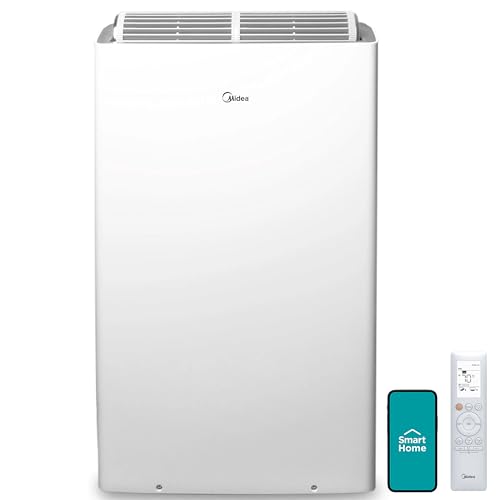
The Midea Duo 14K with Heat is a big-room portable air conditioner that also heats. Midea sells it as the “DUO” because it uses a hose-in-hose design, and it pairs that with a variable-speed inverter compressor, app control and a four-in-one feature set: cool, heat, ventilate and dehumidify. This profile covers what Midea publishes, what the BTU figures mean, how drainage works, and who should pick it or skip it. Specs come from Midea’s product page and from the user manual for the MAP14 family. We did not run the unit ourselves, so everything below is the maker’s own information plus our reading of it.
One naming note first. The Amazon listing linked below is the white finish. Midea’s product page is for model MAP14HS1TBL (black), and the user manual covers a family of MAP14 variants, including the heat versions. The core numbers are the same across them, but check the model number on the listing before you buy.
What Midea Says About the Duo
According to Midea’s product page:
- Cooling rating: 12,000 BTU on the DOE basis, for spaces up to 550 sq ft.
- Modes: cool, heat, ventilate (fan) and dehumidify. The page calls it 4-in-1.
- Compressor: variable-speed inverter technology, which Midea says provides over 40 percent energy savings compared to the U.S. federal standard.
- Noise: “as low as 42 dBA.” That is the quietest setting, not a figure for every mode.
- Hose design: the hose-in-hose layout that Midea says traps cool air and expels hot air.
- Mobility: four wheels for room-to-room moves.
- Control: the SmartHome app, Apple Watch and voice-assistant devices, plus a remote control.
- Filter: reusable and washable.
- Size and weight: 16.73 inches deep, 19.53 inches wide, 32.48 inches high and 77.16 lbs.
- Warranty: 1 year, per the specs list.
- In the package: a flexible exhaust hose and a mounting kit that Midea says fits a variety of window types.
The manual adds the operating ranges. Cooling runs from 60 to 95 degrees F in the room, dry mode from 55 to 95 degrees F, and heat pump mode from 41 to 86 degrees F. The thermostat can be set between 60 and 86 degrees F.
What “12,000 BTU” Means Here
Portable air conditioners carry two kinds of BTU figures. The older ASHRAE-style number is measured in a way that flatters every portable, because it does not fully count the heat the unit adds to the room or the warm air that leaks back in around the hose. The U.S. Department of Energy introduced a more conservative measure, often written SACC or “DOE BTU,” that accounts for those losses. Whynter, another maker we cover, describes SACC as the DOE’s 2017 standard and notes that a unit rated 14,000 BTU on the older basis can come out at 8,500 to 10,000 on the SACC basis, which is labeling, not weakness.
Midea’s page leads with the DOE number, 12,000 BTU, and that is the figure to use when sizing a room. The “14K” in the name echoes the older rating and the manual’s capacity line, which reads 12,000 to 14,000 Btu/h across the models it covers. When you compare the Duo with a 14,000 BTU ASHRAE unit, compare the DOE or SACC figures side by side, or you will be comparing different yardsticks. Our ranking of portable air conditioners uses that approach.
Hose-in-Hose and Inverter, Explained
A traditional single-hose portable pulls room air across its hot coil and blows that air outside. The room then pulls replacement air in through cracks and gaps, and some of that air is hot. A dual-hose design draws outdoor air for the hot side through a second hose, which is why Whynter’s FAQ says dual-hose units cool faster and help maintain room pressure. Midea’s version puts both paths in one hose assembly: one connection, one window panel, no second hose to route. The manual asks you not to overextend or bend the hose and to keep objects at least 20 inches from the inlet and outlet of the hose.
The inverter matters for a different reason. A fixed-speed compressor runs at full power until the room hits the target, then shuts off, then starts again. An inverter slows down as the room approaches the set temperature and holds it with smaller swings. That tends to mean fewer loud on-off cycles at night, which is where Midea’s 42 dBA claim becomes relevant. Midea does not publish noise figures for the higher fan speeds on its page, so assume it will be louder when cooling hard.
Heat Mode, and What It Needs
The Duo is a heat pump, not a resistance heater. Midea’s manual says that in heat mode the unit runs in reverse and that the room temperature range for heating is 41 to 86 degrees F. In heat mode the fan speed cannot be adjusted, per the manual. Because heating produces condensate, the manual says you must install the included drain hose while operating in heat mode, with a universal drain adaptor and an optional 3/4 inch hose for a longer run. The unit has a condensate pump, so the drain hose can be elevated up to 6 ft, but it must not kink and the end must sit at a drain. The package also includes insulation foam for the hose in heat pump mode.
That makes the Duo a shoulder-season tool: a way to take the chill off a room in spring or fall, not a replacement for a furnace. If you only want cooling, a non-heat model is simpler to run, and several brands, including Dreo, sell cooling-only units.
Drainage and Day-to-Day Use
For cooling, the manual shows drain outlets for dry mode, heat mode and excess condensate. When the bottom tray fills, the unit beeps, shows P1 and stops cooling and dehumidifying while the fan keeps running. You then move the unit to a drain, remove the bottom plug and let the water out. In dry mode, you can remove the upper drain plug and attach the drain hose for continuous drainage.
Other practical details from the manual:
- The filter is integrated with a removable upper filter, and Midea says to clean it once every two weeks.
- A sleep mode raises the cooling setpoint 2 degrees F after 30 minutes and again after another 30 minutes, then holds it.
- Auto-restart and a timer are included.
- The remote can work as a remote thermostat: when it is within 26 feet of the unit, the manual says the display shows the temperature at the remote’s location.
- The unit connects to the MSmartHome app in a wireless mode that you start from the control panel.
Setup Notes
The manual describes a window kit built from adjustable sliders, with a table of slider combinations for different window widths and separate steps for hung and sliding windows. You attach foam to the sliders, set the assembly in the window, connect the hose adapter and brace the panel. Take measurements before you buy; the manual’s slider table is the final word on whether your window fits, and casement windows need an aftermarket kit or insert.
Position matters. Keep the hose as short and straight as the layout allows, keep the unit level on an even surface, and keep the area around the hose openings clear. Let the unit stand upright for a while before plugging it in if it shipped on its side, and check the manual for Midea’s wait time.
For power, plug the unit directly into a properly grounded wall outlet. Midea’s manual says not to use an extension cord or adaptor plug and not to share the outlet with other appliances, and it says to have a qualified electrician install a proper receptacle if yours is not grounded. Check the serial plate for the electrical requirements. Any change to wiring or a new circuit is a job for a licensed electrician, and any permanent wall or ceiling vent is a job for a licensed contractor. This profile gives no installation steps for either. Never vent the hose into another room, a garage or an attic; hot air has to leave the building.
Where It Falls Short
- Weight. At 77.16 lbs it is awkward on stairs, even with four wheels.
- Heat mode needs a drain hose. You cannot just let it run unattended in winter without plumbing a hose to a drain.
- Limited noise data. Midea publishes only the 42 dBA best case.
- Short warranty. The specs list 1 year.
- Not meant for cold climates. Heat pump mode stops at 41 degrees F.
Who It Suits
- People with a large living room or open plan, up to the sizes Midea lists, who want a dual-path design without managing two hoses.
- Buyers who want one appliance that cools in summer and takes the edge off in mild weather.
- Smart-home users who want app, watch and voice control.
- Households that dislike the on-off cycling of fixed-speed units.
Who Should Look Elsewhere
- Small bedrooms and dorms do not need this much capacity. The Dreo 740S is also an inverter dual-hose unit, rated for up to 400 sq ft, and smaller rooms are better served by lower-capacity models still.
- Renters who move often may find 77 pounds a drawback; check the weight of the Whynter NEX ARC-1280MX, which Whynter lists at 55 lbs net.
- Anyone who wants a cooling-only unit can skip the heat hardware.
Bottom Line
The Midea Duo 14K with Heat is a capable, quiet-leaning large-room portable with a smart feature set and a heat pump mode that comes with plumbing demands. Size it by the 12,000 BTU DOE figure, plan the drain, and keep the outlet rules in mind. For how it compares with the rest of the models we cover, see our portable air conditioner ranking for 2026.
See price on Amazon
Sources