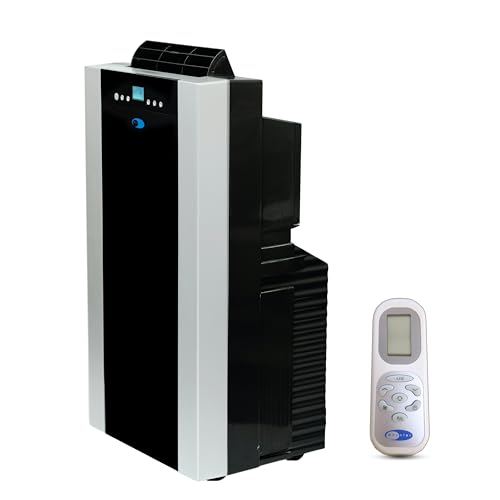
The Whynter ARC-14S is a dual-hose, fixed-speed portable air conditioner aimed at large rooms. Whynter rates it at 14,000 BTU on the ASHRAE basis and 9,500 BTU on the DOE 2017 SACC basis, and lists coverage up to 500 sq ft. It has been part of Whynter’s line for years, and the brand’s page frames it as a versatile, award-winning model. This profile covers what Whynter publishes, how to read the BTU numbers, drainage, venting and power rules, and who should pick it. All specs here come from Whynter’s product page and FAQ. We did not run the unit ourselves.
What Whynter Says About the ARC-14S
According to Whynter’s product page:
- Cooling: 14,000 BTU (ASHRAE-128) and 9,500 BTU (DOE 2017 / SACC), with a dual-hose design.
- Coverage: up to 500 sq ft.
- Modes: air conditioner, fan or dehumidifier. Dehumidifying capacity is listed as 71 pints per day.
- Noise: below 51 dBA on low and below 56 dBA on high.
- Fan: three speeds. Thermostat control from 61 to 89 degrees F.
- Controls: digital and remote control, a 24-hour programmable timer and auto restart after a power outage.
- Filters: an activated carbon air filter and a washable pre-filter, which Whynter says is compatible with 3M filters.
- Hoses: extendable exhaust and intake hoses with a 5.9 inch diameter, up to 60 inches long.
- Window kit: an adjustable kit 6.5 inches wide and 20 to 56 inches long.
- Size and weight: 16 inches wide, 19 inches deep, 35.5 inches high. Net weight is 73 lbs and gross is 97 lbs.
- Power: maximum power consumption of 1,300 watts or 11.6 amps. Refrigerant is R-32. The plug is an LCDI (leakage-current detection and interruption) type.
- Drainage: a patented auto drain function. The spec table lists no pump and no upper gravity drain port.
- Heat: the spec table says Heat Mode: No.
- Warranty: one year on the unit and three years on the compressor.
- Extras: casters, and a storage cover bag with a pocket.
Whynter’s page also lists awards and press mentions, including a Good Housekeeping top-pick designation. Those are the brand’s own list, so we do not weigh them in this profile.
ASHRAE vs SACC, Briefly
The older ASHRAE-128 rating flatters portable air conditioners because it does not fully count the heat the unit adds to the room or the air that leaks in around the hose. SACC, the Department of Energy’s 2017 standard, accounts for variable room conditions, heat from the motor and leakage during venting. Whynter’s own FAQ spells it out: a 14,000 BTU unit on the old basis can have a SACC of only 8,500 to 10,000, which Whynter says is not weaker, just more accurately labeled. The ARC-14S carries both labels on the page, so treat 9,500 BTU as its real-world sizing figure. This is how we compare models in our ranking of portable air conditioners.
Dual Hose, Fixed Speed
Whynter’s FAQ describes dual-hose operation as one hose bringing in outside air and one exhausting warm air, which cools faster and helps maintain room pressure compared with a single-hose unit. The ARC-14S uses that layout, with two 5.9 inch hoses running to the window kit.
It is not an inverter. A fixed-speed compressor runs at full output until the room reaches the set temperature, shuts off, then restarts when the room drifts back up. That cycling is usually more audible than an inverter’s slow, steady running, and it is part of why the noise rating is 51 to 56 dBA. Whynter’s inverter models, such as the NEX ARC-1280MX, are the brand’s answer to that, and they add app control that the ARC-14S lacks. The trade is simplicity: fewer electronics, a long track record and a compressor that Whynter backs for three years.
Drainage
Whynter describes a patented auto drain function that “fully exhausts all condensate automatically in most environments.” In practice that means the unit evaporates and expels moisture through the exhaust. In humid climates, the FAQ says the unit may fill faster than it evaporates, and then the display shows STOP, P1 or FL. At that point you drain it manually from the lower rear port into a shallow pan or Whynter’s drain bucket accessory. Whynter’s FAQ also suggests dehumidifier mode with a continuous drain hose in those conditions, although the ARC-14S spec table lists no upper gravity drain port, so check which port the model offers before you plan a hose run.
Setup Tips
- Measure your window. The kit runs from 20 to 56 inches. Whynter says the panel with the hose cutout can be trimmed from the end opposite the cutout. Casement windows need an aftermarket kit or custom insert.
- Keep hoses short and straight. Whynter does not recommend extending them. If you must, Whynter says not to exceed 9 feet in total length and not to connect multiple hoses or use duct tape as a permanent seal.
- Let it settle. Whynter says to stand the unit upright for at least 2 hours before plugging it in, or 24 hours if it shipped on its side.
- Plug into the wall. Use a properly grounded wall outlet rated for the unit, ideally on a dedicated circuit, with no lightweight extension cord, adapter or undersized power strip. Do not bypass the LCDI plug. If you have no suitable outlet, Whynter says to consult a licensed electrician.
- Vent outdoors only. Whynter’s FAQ says never to vent into another room, a garage or an attic. A wall vent, ceiling plenum or new circuit is a job for a licensed contractor or electrician, and this profile gives no steps for it.
- Clean the filters every two weeks. Whynter says to rinse the washable filters in warm water and let them dry; the carbon filter should be replaced every 2 to 3 months.
Where It Falls Short
- Not an inverter. Expect on-off cycling and a noise rating of up to 56 dBA.
- Weight. At 73 lbs net, it is heavy, even with casters.
- No smart features listed. The page lists a digital display and remote, not an app or voice control.
- No heat. Cooling only.
- Drain options. No pump and no upper gravity drain port are listed, which matters in humid basements.
- Age of the design. Newer inverter models list better efficiency figures, such as the 12.1 CEER Whynter lists for the ARC-1280MX.
Who It Suits
- Owners of a large living room, workshop or open-plan space up to 500 sq ft who want a dual-hose unit without inverter electronics.
- Buyers who value the three-year compressor warranty.
- People who want a carbon filter and a dehumidifier mode in a no-app unit.
- Anyone who wants simple controls: remote, display and timer.
Who Should Look Elsewhere
- Bedroom sleepers may prefer an inverter such as the Whynter NEX ARC-1280MX for steadier running.
- Smart-home users will find the Dreo AC515S or the NEX with app control a better match.
- Renters who move units often may find 73 lbs too much.
Bottom Line
The Whynter ARC-14S is a proven, fixed-speed, dual-hose portable with a clear SACC figure, a patented auto drain and a long compressor warranty. It lacks an inverter, heat and an app, and it is heavy. Size it by the 9,500 BTU SACC number, keep the outlet and venting rules in mind, and compare it with the rest of our portable air conditioner ranking for 2026.
See price on Amazon
Sources