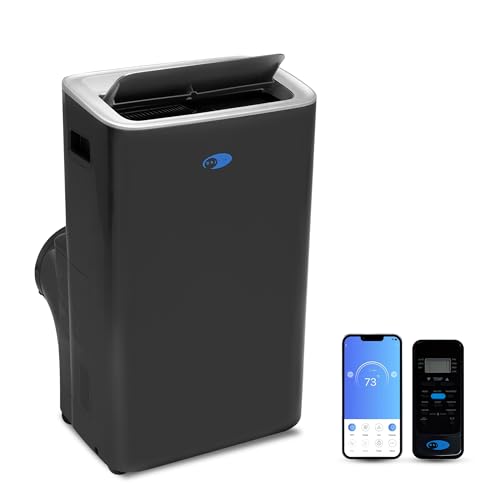
The Whynter NEX ARC-1280MX is a smart, dual-hose, inverter-driven portable air conditioner for mid-to-large rooms. Whynter lists it at 13,000 BTU on the ASHRAE basis and 10,000 BTU on the SACC basis, for spaces up to 500 sq ft, and it comes in a compact body at 55 lbs net. This profile covers what Whynter publishes, how to read the BTU numbers, drainage, venting and power rules, and who should buy it. Everything here comes from Whynter’s product page and FAQ. We did not run the unit ourselves.
What Whynter Says About the ARC-1280MX
According to Whynter’s product page:
- Cooling: 13,000 BTU (ASHRAE) and 10,000 BTU (SACC), with NEX Inverter technology and dual-hose operation.
- Coverage: up to 500 sq ft.
- Dehumidifying capacity: 96.8 pints per day.
- Noise: 50/53/56 dBA in Whynter’s spec table. The page does not say which fan speed each number belongs to, so read it as a range from about 50 to 56 dBA.
- Fan: five speeds (continuous, auto, low, medium, high), with a fully automatic 80-degree airflow louver. Airflow at low, medium and high is listed as 225, 244 and 388 CFM.
- Temperature range: thermostat control from 60 to 86 degrees F.
- Controls: digital display and remote, a NetHome Plus app, and voice control through Alexa, Google Home and Apple Siri. There is a 24-hour timer, sleep mode, auto-restart and a filter check reminder.
- Filters: washable air filter plus an activated carbon filter.
- Hoses and window kit: dual exhaust and intake hoses, 7.5 inches in diameter and up to 60 inches long. The 3-piece window kit is 6.5 inches wide and adjusts up to 82 inches.
- Size and weight: 17.36 inches wide, 15.63 inches deep, 28.62 inches high. 55 lbs net, 74 lbs gross.
- Power: 115 V, 60 Hz, with a maximum cooling power draw listed as 1212 W or 11.9 A. Refrigerant is R32.
- Efficiency: CEER 12.1 and EER 9.9, UL listed.
- Warranty: one year on the unit and three years on the compressor.
- Heat: the spec table says Heat Mode: No.
ASHRAE BTU vs SACC
Portable air conditioners are labeled two ways. The older ASHRAE number comes from a test that does not fully count the heat the unit generates or the warm air that leaks back into the room around the hoses, so it reads high. SACC, short for Seasonally Adjusted Cooling Capacity, is the Department of Energy’s 2017 standard. Whynter’s FAQ explains that SACC accounts for variable room conditions, heat added by the motor and air leakage during venting, and that a unit rated 14,000 BTU on the old basis might come out at 8,500 to 10,000 on SACC without being weaker, just more honestly labeled. Whynter adds that a dual-hose design generally gets a higher SACC for the same ASHRAE number.
For the ARC-1280MX, that means the useful figure is 10,000 BTU SACC. When you compare it with another portable, compare SACC to SACC, or DOE to DOE. Our ranking of portable air conditioners lines models up this way.
Dual Hose and Inverter, in Plain Terms
A single-hose portable cools the room with air it also uses to carry heat outdoors. That pulls replacement air in through gaps and makes the unit work harder. Whynter’s FAQ describes the dual-hose alternative: one hose brings in outside air, the other exhausts warm air, which cools faster and helps maintain room pressure. The ARC-1280MX uses that layout, so you run two 7.5 inch hoses to the window panel.
The NEX inverter changes how the compressor behaves. Instead of running flat out and shutting off, an inverter compressor adjusts its speed as the room approaches the set temperature. Whynter says that delivers high energy efficiency and quiet cooling performance, and the CEER of 12.1 is on the page. Whynter’s noise numbers are 50 to 56 dBA, though, which is not whisper quiet, so if bedroom silence is your top priority, check the figures for other models in the ranking.
Drainage
The ARC-1280MX uses self-evaporation: water is carried out with the hot exhaust air. In humid weather that may not keep up. Whynter lists both a lower rear drain port and an upper gravity drain port for continuous operation. Whynter’s FAQ says to attach a hose to the upper port pointing downward so water leaves by gravity, with no kinks and no uphill runs. If the display shows STOP, P1 or FL, the internal tank is full and you need to drain it manually or confirm the drain hose is connected. For manual drainage, Whynter suggests a shallow pan or its drain bucket accessory under the lower port.
Setup Tips
- Measure your window before you order. The kit is 6.5 inches wide and extends to 82 inches. Whynter says the panel with the hose cutout can be trimmed from the end opposite the cutout if it is too long.
- Keep hoses short and straight. Whynter does not recommend extending the hoses; if you must, it says not to exceed 9 feet in total hose length, to avoid sharp bends and vertical lifts and never to connect multiple hoses or rely on duct tape as a permanent seal.
- Let it stand. Whynter says to let the unit stand upright for at least 2 hours before plugging it in, or 24 hours if it shipped or traveled on its side.
- Casement windows need an aftermarket kit or a custom insert, per Whynter.
- Plug directly into the wall. Whynter says to use a properly grounded wall outlet rated for the unit, ideally on a dedicated circuit, and to avoid lightweight extension cords, adapters and undersized power strips. If a suitable outlet is not available, Whynter’s advice is to consult a licensed electrician. Do not bypass the LCDI plug on the cord.
- Vent outdoors only. Whynter’s FAQ says never to vent into another room, a garage or an attic. Wall vents, ceiling plenums and any new circuit are jobs for a licensed contractor or electrician, and this profile gives no steps for them.
Where It Falls Short
- No heat mode. Whynter lists none, so it is a cooling-only product.
- Noise. 50 to 56 dBA is middle of the pack for an inverter.
- Window width. An 82 inch maximum covers many windows but not all; check yours.
- Warranty. One year on the unit is typical, with the three-year compressor term as the bright spot.
- Setup effort. Two hoses mean more parts to seal than a single-hose unit.
Who It Suits
- Owners of a 300 to 500 sq ft living room or open-plan space who want a dual-hose inverter with a listed net weight of 55 lbs.
- People who want app and voice control and a 24-hour timer.
- Buyers who want a three-year compressor warranty from a brand that has sold portables for years.
Who Should Look Elsewhere
- Buyers who need heating should look at models with a heat mode, such as the Midea Duo 14K with Heat.
- People who want a simpler, non-inverter dual-hose design can compare the Whynter ARC-14S, which Whynter rates at 14,000 BTU ASHRAE and 9,500 BTU SACC.
- Small bedrooms and dorms do not need 10,000 SACC, and a smaller unit will draw less power.
Bottom Line
The Whynter NEX ARC-1280MX combines the dual-hose layout and an inverter with smart control and a listed 55 lb net weight. Size it by the 10,000 BTU SACC figure, keep the outlet and venting rules in mind and check your window width. For the full lineup, see our portable air conditioner ranking for 2026.
See price on Amazon
Sources