We earn a commission if you buy through our links, at no extra cost to you.
Portable Air Conditioner for a Room With No Windows
Can a portable AC work in a windowless room? Every real one must vent outdoors. Venting options, dual vs single hose and three models that fit.
At a glance
A room with no windows can only use a portable air conditioner if the exhaust hose reaches the outdoors through a sliding door kit, drop-ceiling panel, casement insert or wall vent. The Whynter ARC-14S and Whynter NEX ARC-1280MX are dual-hose units, and the Dreo AC515S is a single-hose option.
A portable air conditioner can cool a room with no windows only if you find another way to send its hot exhaust air outdoors. There is no workaround that skips this step. Every real portable air conditioner has to vent hot air outside, and the marketing language around “no hose” and “no window needed” is where most shoppers get misled. This guide explains what actually works for a windowless bedroom, a basement room, an interior office or a room with only casement windows, and which models on this site have the right hose setup. We did not run any of these units ourselves. Everything below comes from the makers’ own pages and the U.S. Department of Energy.
If you want the whole lineup instead of a venting-focused shortlist, see our ranking of the best portable air conditioners for 2026.
Why Every Real Portable AC Needs to Vent Outdoors
An air conditioner does not make cold. It moves heat from the room air into a refrigerant loop and then has to dump that heat somewhere. A portable unit is a single cabinet standing inside your room, so the heat has to leave through a hose. The Department of Energy’s definition of a portable air conditioner describes a portable encased assembly that delivers cooled, conditioned air to an enclosed space and includes a source of refrigeration. That refrigeration cycle is why the hose is not optional. Whynter’s FAQ puts it plainly: all portable ACs must vent hot air to the outside to cool effectively.
If you have seen a product advertised as a portable air conditioner “with no hose” or “no window needed,” read the listing closely. A product that does not vent heat outdoors is not running a refrigeration cycle into the outdoors. In practice it is a fan or an evaporative cooler, which cools by adding moisture to the air, and a sealed windowless room is the worst place to add moisture. We do not rank or recommend those products, because they are not air conditioners and will not behave like one.
Venting Options When There Is No Standard Window
Whynter’s FAQ, which answers the question “Can I use a portable AC without a window?”, lists the realistic alternatives. Here is how to think about each one.
- Sliding door kit. Whynter lists vertical sliding doors with a kit as a way to route the hose. This suits a patio-door room that has no window, but you give up part of the door opening while the unit is running.
- Drop-ceiling panel. Whynter lists drop-ceiling panels, and its FAQ elsewhere says to always vent outdoors through a window, wall or ceiling plenum. Note the word outdoors. A ceiling tile that opens into the space above a drop ceiling is not outdoors, so the duct has to continue all the way out of the building.
- Wall vent. Whynter lists a dedicated wall vent installation. Cutting an opening in an exterior wall is work for a licensed contractor, and we do not give installation steps. Ask about local building rules and, in a rental, about your lease before anyone touches the wall.
- Casement window insert. If the room has a casement or awning window, the answer is yes, with the right kit. Whynter says casement windows work with an aftermarket casement window kit or a custom insert made from Plexiglas or acrylic, and it points to a partner that makes custom-fit inserts.
Whynter’s FAQ also says window kits work with both vertical (sliding) and horizontal (sash) windows, and that you measure your opening and cut the panel to fit for a secure seal. That is the standard route. The options above are what you turn to when the standard route is not available.
What You Must Never Do
Never run the hose into another room, a garage or an attic. Whynter’s FAQ says the exhaust carries both heat and moisture, so venting into an interior space pushes that heat back into your home and creates condensation and mold risk in the receiving space. It also says to always vent outdoors through a window, wall or ceiling plenum.
This rule is the reason a windowless room is a hard case. Moving the hose into the hallway or a closet feels like a solution because the room itself gets cooler for a while, but you are only relocating the heat, and the unit will work harder as the rest of the home warms up.
Keep the hose short and direct, too. Whynter does not recommend extending the exhaust or intake hose, and says that if extension is absolutely necessary the total hose length should not exceed 9 feet, with no sharp bends or vertical lifts. Longer runs can reduce cooling efficiency and increase backpressure on the compressor. For a windowless room, this means the unit should sit close to wherever the vent point ends up, and you should plan the position before you buy.
Dual Hose or Single Hose?
The difference matters more in a room with a non-standard vent, because pressure and airflow behave differently there.
According to Whynter’s FAQ, a single-hose unit pulls air from the room to cool it, has a simpler setup and is less efficient in large or sunny rooms. A dual-hose unit uses one hose to bring in outside air and one to exhaust warm air, which Whynter says cools faster and helps maintain room pressure. Whynter also says a dual-hose design will generally have a higher SACC for the same ASHRAE rating. SACC, short for Seasonally Adjusted Cooling Capacity, is the number from the Department of Energy’s test procedure, and it is the one to size against. The ASHRAE figure is the older, more generous label.
A single-hose unit takes air from the room and sends it outside, so that air is replaced by warmer air leaking in from elsewhere. In a sealed interior room that leakage comes from the rest of the house instead of from outdoors. That is one reason we favor dual-hose models for windowless rooms, but you now have two openings to plan for instead of one. Check that your sliding door kit, casement insert or wall vent can handle both hoses before you order.
Three Models Worth Considering
We picked these because they cover both hose designs and the sizes most windowless rooms need. Whynter sizing guidance, which it presents as general reference, points rooms up to 300 sq ft to 8,000 to 10,000 BTU and 300 to 500 sq ft to 11,000 to 14,000 BTU. Interior rooms usually have less sun gain than a room with an exterior wall of glass, but appliances and people still add heat.
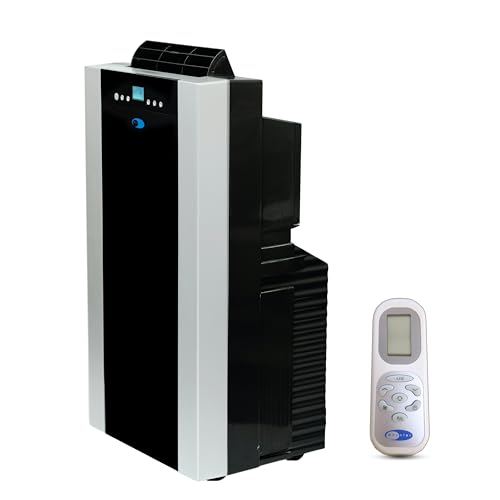
Whynter ARC-14S: A Dual-Hose Classic for Larger Rooms
A dual-hose unit rated 9,500 BTU SACC for spaces up to 500 sq ft, with a published exhaust hose length of up to 60 inches.
Whynter lists the ARC-14S at 14,000 BTU on the ASHRAE basis and 9,500 BTU SACC, with coverage up to 500 sq ft. Both the exhaust and the intake hose are 5.9 inches in diameter and extend up to 60 inches, and the window kit adjusts from 20 to 56 inches in length. It has no heat mode and no pump, and Whynter lists its noise at below 51 dBA on low and below 56 dBA on high. It weighs 73 lbs net. For a windowless room, its appeal is that the dual-hose design is built for the kind of sealed space where room pressure matters, and the hose length gives you some placement flexibility. Read the details in our ARC-14S profile.
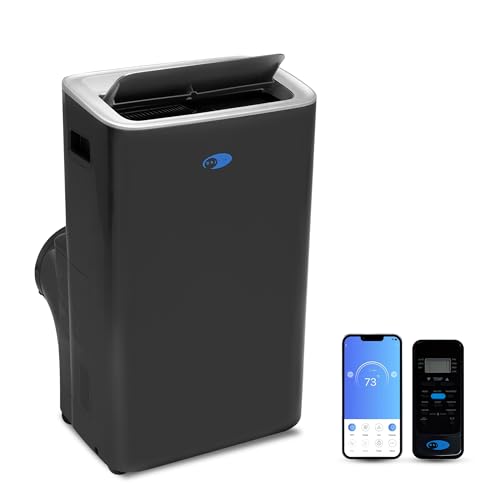
Whynter NEX ARC-1280MX: Dual Hose With an Inverter
A dual-hose inverter rated 10,000 BTU SACC for up to 500 sq ft, with a 3-piece window kit that adjusts up to 82 inches.
Whynter lists 13,000 BTU ASHRAE and 10,000 BTU SACC, a dual-hose design, a maximum exhaust hose length of 60 inches and a noise range of 50/53/56 dBA. The long adjustable window kit, up to 82 inches, is a useful detail if your venting point is a wide sliding door or a custom insert rather than a standard window, since you can adapt the panel to the opening. At 55 lbs net it is lighter than the ARC-14S. Whynter covers it for one year, with three years on the compressor. More in the Whynter NEX ARC-1280MX profile.
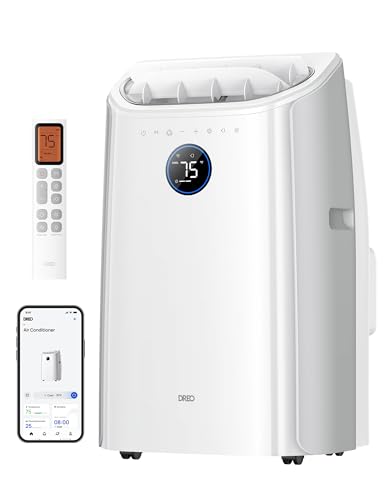
Dreo AC515S: A Single-Hose Option for Smaller Rooms
A single-hose unit rated 12,000 BTU (ASHRAE) for about 300 sq ft, with a universal window kit and a drainage-free system.
Dreo’s page lists the AC515S at 12,000 BTU on the ASHRAE basis, a floor area of 300 sq ft, 46 dB and a universal window kit for windows up to 53 inches. Its FAQ confirms it is a single-hose design and that the hose can go into a vertical or horizontal sliding window. Because it has one hose, it has a simpler route to plan, which suits a small interior room where you can run a single duct through a door kit or a wall vent. Dreo’s FAQ says condensation is minimal and is evaporated by its self-evaporating system when humidity is below a set level, and that a P1 code means the water collection tray is full. Remember that the larger figure is ASHRAE, so size against the SACC number when it is available. Our Dreo AC515S profile has the full spec rundown.
Power: Plug Directly Into the Wall
A windowless room is often a basement, an interior bedroom or an add-on space, where outlet quality varies. Whynter recommends plugging your portable air conditioner directly into a properly grounded wall outlet rated for the unit, ideally on a dedicated circuit, with no lightweight extension cords, adapters or undersized power strips, and says to consult a licensed electrician if a dedicated outlet is not available. Follow the manual that comes with your unit for its power requirements, and have a licensed electrician add any new circuit or outlet. We do not give steps for that work.
Quick Decision Guide
- Interior room up to 500 sq ft, dual-hose, simple controls: Whynter ARC-14S.
- Wide sliding door or custom insert, want an inverter: Whynter NEX ARC-1280MX.
- Smaller room, one duct to route: Dreo AC515S.
- Room with only a casement window: any of the above, with an aftermarket casement kit or a custom insert.
Before You Buy
Decide the vent point first, then measure it. Confirm the hose can reach it without extension, that the kit fits the opening, and that the outlet is grounded and close enough to plug into directly. If the only way to vent the room is a wall or ceiling penetration, talk to a licensed contractor before ordering a unit. For the full lineup side by side, return to the main portable air conditioner ranking.
Sources
Frequently asked questions
Can a portable air conditioner work in a room with no windows?
Only if you can route its exhaust hose outdoors some other way. Whynter's FAQ says all portable air conditioners must vent hot air to the outside to cool effectively, and lists sliding doors (with a kit), drop-ceiling panels and wall vents as alternatives to a window. A wall vent is a job for a licensed contractor.
Is there a portable air conditioner with no hose?
Not a true air conditioner. A refrigeration-based portable AC has to push the heat it removes somewhere, and that is the job of the exhaust hose. Products sold as no-hose or no-window-needed coolers do not vent heat outdoors, so they work differently and should not be expected to cool a room the way an air conditioner does.
Can I vent a portable AC into the next room, a garage or an attic?
No. Whynter's FAQ says the exhaust carries both heat and moisture, so venting into an interior space pushes the heat back into your home and creates condensation and mold risk in the receiving space. It says to always vent outdoors through a window, wall or ceiling plenum.
Can a portable air conditioner be installed in a casement window?
Yes. Whynter's FAQ says casement windows work with an aftermarket casement window kit or a custom window insert made from Plexiglas or acrylic. A casement window is a possible way to vent a room that has no sliding or sash window.
Is a dual-hose or single-hose unit better when the vent is awkward?
Per Whynter, a dual-hose unit brings in outside air through one hose and exhausts warm air through the other, cools faster and helps maintain room pressure, while a single-hose unit is simpler but less efficient in large or sunny rooms. Two hoses also mean two connections to route, so check that your vent point can take both.
Can I plug a portable air conditioner into an extension cord?
Follow the manual, but the guidance we found is to plug directly into a properly grounded wall outlet. Whynter says ideally on a dedicated circuit, with no lightweight extension cords, adapters or undersized power strips, and to consult a licensed electrician if no suitable outlet is available.